
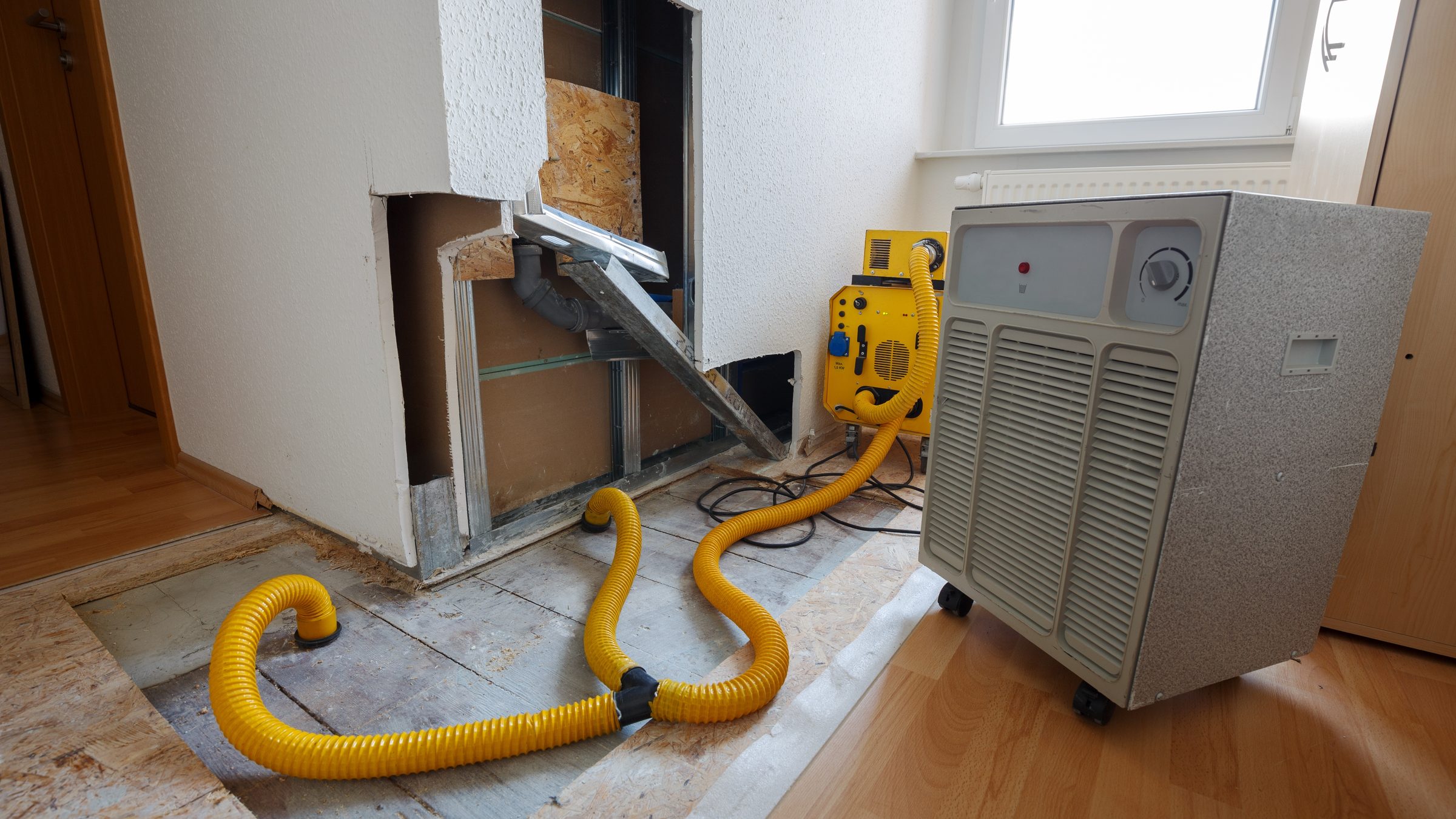
Water emergency · 24/7
Emergency Water Damage Restoration
Water is in the building and the clock has already started. Here is what to do in the next hour, what happens when you call, and how to tell whether this needs a crew tonight.
- Rapid response teams
- On standby
- Phones answered
- 24/7
- Counties & boroughs
- 7
Certified & licensed · Fully insured · We handle your insurance
Our certifications and credentials
IICRC Certified Technicians
Industry standard certification
OSHA Certified
Safety trained crews
25+ Years Experience
Ownership, in restoration
Licensed & Insured
Certificate on request
What counts as an emergency
What emergency water damage restoration actually means
Emergency water damage restoration is the work that has to happen in the first hours of a water loss: stop the source, remove standing water, and get drying equipment running before the building has a night to soak.It is the same trade as any other water damage restoration job. What makes it an emergency is not the volume of water, it is how many hours it has been sitting, because that is the number that decides whether this ends as a drying job or as a rebuild.
Three things move a water emergency to the front of the queue, and none of them is how big the puddle looks. First, whether the water is still flowing. Second, the category — clean supply water, grey water off an appliance, or sewage. Third, whether it is running across or near electrical equipment. A slow, clean, contained leak can reasonably wait until morning. Contaminated water in a finished room cannot, and neither can water flowing through a ceiling.
Call tonight, not tomorrow, if
- There is standing water anywhere you would normally walk
- The water has crossed a ceiling, or a ceiling is sagging or bulging
- It is sewage, or it has come up through a floor drain or a toilet
- It reached a finished space with carpet, drywall or cabinetry in it
- Anyone in the building is immunocompromised, elderly or an infant
- You cannot find the source, which usually means it is inside a wall
What causes most emergency calls
The list is shorter than people expect, and almost none of it is weather. Burst pipes and broken pipes in an unheated wall or crawlspace during the first hard freeze. Failed water heaters, which let go all at once and put forty to eighty gallons across a floor. A washing machine or dishwasher water supply hose, which is the single most common appliance failure we see. Sewage backups through a floor drain. Roof leak and clogged gutters during heavy rain, which is the one that gets missed for weeks because it appears as a stain rather than as a flood. And leaky pipes under a sink or behind a fridge — minor leaks that were never minor, they were just hidden.
Storm flooding and a sudden flood from rising water are a different conversation, because they are a different insurance policy and often category three water on arrival. Weather-caused loss sits on ourstorm damage restorationpage; general flood damage and flood restoration are handled under the mainwater damage restorationservice. Groundwater and sump pump failure in a finished basement has its own page too, atflooded basement cleanup.
The first hour
What to do before anyone arrives
Nothing on this list needs a tool you do not own, and every item on it changes the size of the job. Do them in this order.
Do this
Shut the water off at the main. Not at the fixture. If you do not know where the main is, now is when you find out, and it is worth knowing before you need it.
Kill the power to the affected areas. From the panel, if you can reach the panel without standing in water. If you cannot reach it dry, leave the building and tell us on the phone.
Photograph everything before you move it. Wide shots and close-ups, including the water line on the wall. This is the evidence your insurance company will ask for and it costs nothing to take too many.
Get personal belongings up off the floor. Anything absorbent, anything with a metal foot that will stain carpet, and anything irreplaceable. Paper and photographs first.
Open the cabinets and lift the toe kicks. Trapped air under a sink cabinet is where water sits and nothing dries.
Call, and describe what you can see. Where it came from, whether it stopped, and how far it has travelled. That is enough for us to decide what to send.
Do not do this
Do not use a household vacuum. A shop vac is fine for clean water. A regular vacuum on a wet floor is an electrocution risk and it will not survive it either.
Do not walk through water with the power on. Especially in a basement, where the panel and the water are usually in the same room.
Do not touch sewage or floodwater. Category three water carries pathogens and it does not become safe because it looks clear. That is a decontamination job, not a mopping job.
Do not leave wet carpet down to dry. The pad underneath holds water against the subfloor and it will not dry in place. It comes up, or the floor under it stays wet.
Do not run the ceiling fan under a wet ceiling. If a ceiling is holding water, adding load and vibration to it is how it comes down. Pierce it deliberately with a small hole and a bucket instead.
Do not wait for the adjuster to authorize drying. Delay is not covered. Carriers expect you to prevent further damage, and the mitigation is normally paid as its own line anyway.
The clock started when the water did
What happens if you wait
Restoration is priced by how far the damage got, and damage is a function of time. This is the progression we see on almost every untreated water loss.
Minutes
Water finds every porous thing you own
It wicks up drywall, under flooring, and into subfloor and insulation. What you can see on the floor is a fraction of what is already wet.
1-24 hrs
Drywall swells, finishes bleed, odor starts
Furniture legs stain carpet. Laminate delaminates. Paper-faced drywall loses structural integrity and the first musty smell appears.
48-72 hrs
Mold begins to colonize
This is the line that changes the job. Past roughly 48 hours a drying job becomes a remediation job, and the cost and disruption both step up.
1 week +
Structural damage and health risk
Wood warps and swells, fasteners corrode, and spore counts climb. Restoration times and costs rise sharply, and some contents stop being salvageable.
Timelines describe typical residential water losses under normal indoor conditions. Category, temperature, humidity, and materials all shift them. An on-site inspection is the only way to know where your property sits.
Our process
How an emergency water damage restoration call actually runs
No step here is optional and none of them can be reordered. If a contractor skips one, ask which.
01
The call, and what we ask
Address, where the water is coming from, whether it is still flowing, and whether the power to the affected areas is safe. Four questions, because the answers decide what goes on the truck. You get a straight answer on the phone about whether this needs a crew tonight or first thing tomorrow.
02
Make safe before anything else
Standing water over live electrical equipment is the only part of this job that can kill you. We establish whether power can stay on, whether a sagging ceiling is holding weight, and what category the water is, before anyone starts moving personal property.
03
Stop the source, then remove standing water
A burst pipe or a failed supply line gets shut at the main. Then submersible pumps take the bulk and truck-mounted water extraction takes the rest, because the last half inch is the part that soaks into subfloor and porous materials.
04
Map the water, not the puddle
Moisture meters and thermal imaging find hidden moisture behind baseboard, inside wall cavities and under flooring. What you can see on the floor is routinely a third of what is already wet, and drying only what is visible is how a job comes back.
05
Set drying equipment on the same visit
Air movers and refrigerant dehumidifiers go in before we leave, not the following morning. Drying equipment left until tomorrow loses the whole first night, and the first night is when drying does the most good.
06
Meter daily, document daily
Readings are taken every day against the dry standard for that material, and the log goes to your insurance company with the photographs. We stop when the structure hits the number, not when the calendar says three days.
Call us
If it is happening right now, call
Use whichever line matches the property. A person answers, day or night, and you will get a straight answer about whether this needs a crew tonight or first thing tomorrow.
Answered 24 hours a day, 7 days a week
On the truck
Water extraction and structural drying, and what each machine is for
Emergency water extraction is two different jobs done with two different machines, and the second one is where most DIY attempts stop. Submersible pumps move volume — they take a flooded room down from inches to damp. Truck-mounted and portable extraction units then pull excess water out of carpet, pad and hard flooring under vacuum, which a pump physically cannot do.
Then the structural drying starts, and it is not the same thing as airflow. Air movers push air across wet surfaces to speed evaporation. Refrigerant dehumidifiers take that evaporated water back out of the air, which is the step rental fans do not do. Run air movers without dehumidification and you have not dried a building, you have moved the water into the wall cavity and the ceiling above.
The specialized equipment that actually decides the outcome is the smallest: moisture meters and a thermal camera. Penetrating and non-penetrating meters read the moisture content of the material itself, and the thermal camera shows where water travelled behind finishes. That is how affected areas get mapped, how we know which porous materials come out and which dry in place, and how the entire process gets a defined end point instead of a guess.
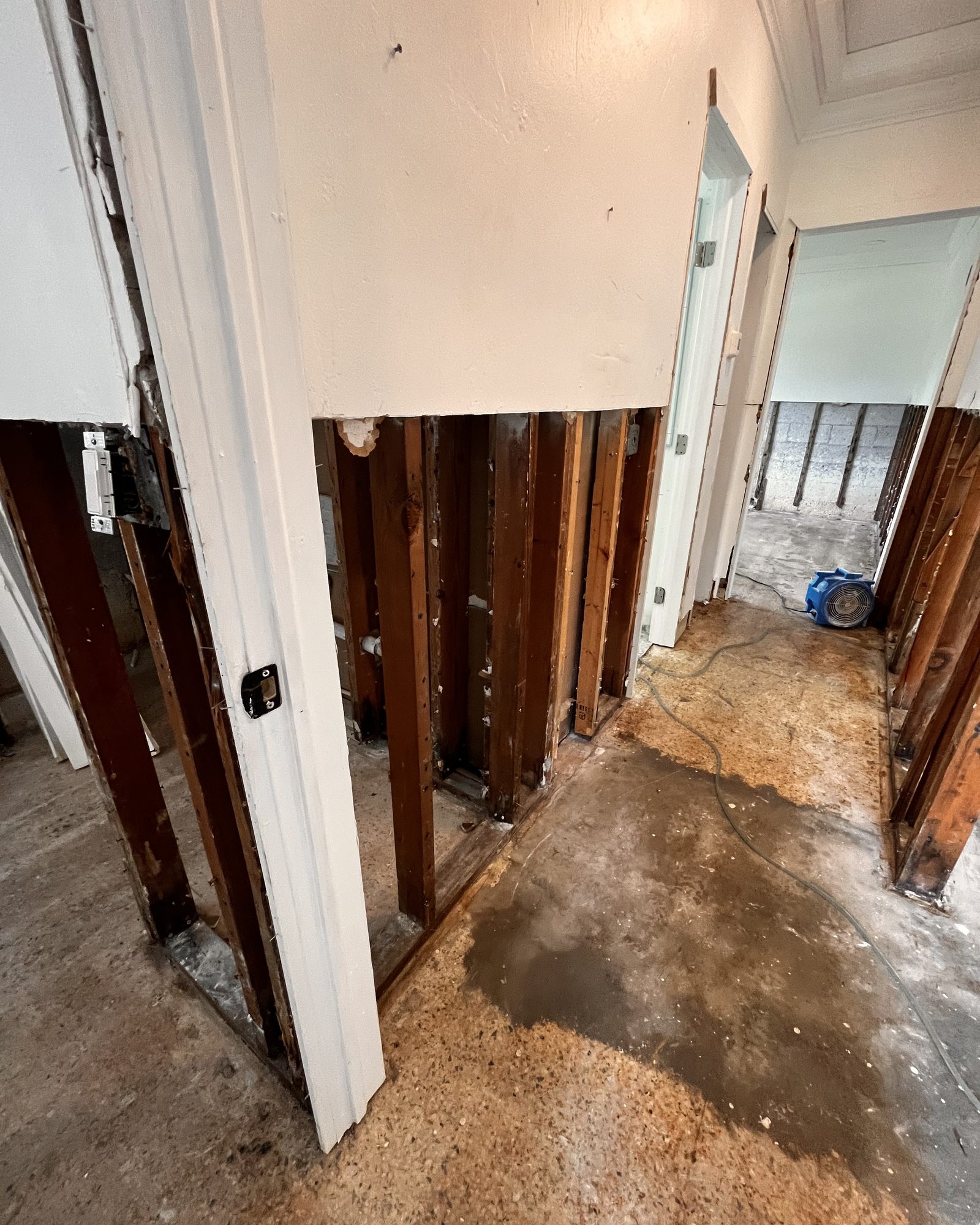
Extraction first, then air movers and a dehumidifier set on the same visit. The machines that decide the outcome are the meters, not the fans.
The words on your estimate
Water mitigation, remediation and restoration are three different things
The restoration industry uses these three words as if everyone knows which is which, and then writes them as separate lines on your estimate. They are stages, not synonyms, and the difference is what your insurance company is paying for at each point.
| Stage | What it is | When |
|---|---|---|
| Water mitigation | Stopping the loss getting bigger. Emergency water removal, extraction, drying equipment, and pulling out materials that cannot be saved. | Hours 0–72 |
| Remediation | Dealing with what grew or contaminated while the building was wet. In practice this means mold remediation, or sewage cleanup where the water was category three. | Day 3 onward, if it is needed |
| Restoration | Putting the building back. Drywall, flooring, trim, paint and cabinetry, returning the property to pre loss condition. | After the structure reads dry |
The practical consequence: mitigation is usually authorized and paid as its own line, which is why emergency water damage cleanup can start before anyone has agreed the cost of the repair. Waiting for the whole claim to be settled before drying is the most expensive mistake available to you, and it is not one your carrier is asking you to make.
What happens next
What emergency water cleanup turns into, and when
Most water losses end when the structure reads dry. Three things turn a mitigation job into a longer one, and it is worth knowing which you are looking at before you agree a scope.
Mold, at roughly 48 hours
Drying fast is how you prevent mold growth in the first place. Once mold growth has started in a wet cavity, the water damage restoration process gains a containment step, negative air and a clearance test, and mold damage is scoped and priced separately from the drying. It is the most common reason an emergency call becomes a two-week job. That work ismold remediation.
Category three water
Sewage damage is not a drying problem, it is a decontamination problem. Porous materials come out rather than get dried, everything remaining is treated, and the sewage cleanup is documented differently for the claim because the carrier is paying for removal rather than for drying. Do not let anyone dry category three water in place.
Water from firefighting
After a fire, the water is its own loss sitting on top of the fire damage, and it gets extracted and dried before any soot work starts. Same trade, different sequence, and it is why afire and smoke damagejob usually begins with a water extraction crew.
And then the repair
Water damage repair — drywall, flooring, trim and cabinetry — is a separate stage from the cleanup and restoration work in front of it. We hold both, so there is no gap where the mitigation contractor leaves and nobody has scheduled the rebuild. That is one call rather than three, and on extensive damage it is most of the difference between a six-week job and a four-month one.
The insurance claim, and why the first day decides it
The insurance claims process on a water loss turns on two things: whether the event was sudden and accidental, and whether you can show what the property looked like before anything moved. The first is decided by what failed. The second is entirely in your hands and it is decided in the first hour.
So the documentation is part of the job, not paperwork after it. We photograph before we touch anything, record the category of the water, log moisture readings daily against the dry standard, and keep a salvage-versus-replace list for personal property rather than discarding quietly. That log is what turns "the floor was wet" into a defensible line item. Property damage claims are settled on documentation rather than on argument, and the argument you are avoiding is the one about whether the drying was necessary at all.
We bill most carriers directly and deal with your adjuster ourselves. The claim stays yours — you should not have to project-manage it from a house you cannot live in. If you want the longer version, theinsurance claims page walks through what carriers ask for and in what order.
What a restoration company should tell you on the phone
You are choosing a water damage restoration company in the worst possible conditions, at night, under pressure, from whoever answers first. Four things separate a real firm from a truck with a magnet on the door, and you can check all four before anyone arrives.
- A person answers, not an answering service taking a message for the morning
- They ask about the power and the water source before they ask about your policy
- They will not quote a restoration price over the phone, because the scope is not knowable yet
- They can tell you what equipment is coming and when it will be set, not just that someone is on the way
Restoration certification is worth asking about too. Our technicians hold IICRC certification and crews are OSHA safety trained, which is the standard the drying process and the readings are worked to. Ask any water restoration company the same question and ask to see it. A water damage restoration company that cannot produce a certificate is telling you something.
Long Island & the boroughs
Emergency water restoration services across Long Island and NYC
Two things about this region change how a night call runs. Long Island finishes its basements, so a supply-line failure that would be a wet slab elsewhere is a full-floor loss here, with carpet, drywall and cabinetry in the water. And the boroughs stack the problem vertically: in an attached house or a pre-war building, water from one unit is a water emergency in three, and the first conversation is often with a managing agent rather than an owner.
The practical difference at 2am is access. A Nassau or Suffolk job is a driveway, a hose run and a crew. A Manhattan or Brooklyn job is a service elevator, a certificate of insurance for the building, and floor protection down before a single machine moves. Both are normal. Telling us which one you have on the first call is what stops the truck arriving without the right equipment, because water damage restoration services in this region are not one job description.
Response time is a function of where the truck starts, not where the office is. That is why crews sit in each of the six markets below rather than running water damage restoration near the property from a single depot across a bridge, and it is what lets the water cleanup begin the same night rather than the next afternoon.
Commercial properties get the same emergency services with one difference: the scope starts from keeping you trading. Containment isolates the loss so the unaffected part of the building stays open, and the work is phased around your hours. That iscommercial restoration, and commercial water damage restoration is the largest share of it.

The call is answered by a person, day or night. Fast response starts with somebody actually picking up, not with a promise on a website.
Where we work
Seven markets we cover
Response time is a function of where the truck starts, not where the office is. We keep crews close to every market we cover.
- Suffolk County
Suffolk runs from the Nassau line to Montauk, which means one crew can be pumping out a slab-on-grade ranch in Brentwood while another is tarping a roof on the East End.
- Rapid response teams on standby
- Licensed and insured
- Nassau County
Nassau is dense post-war housing stock with finished basements almost everywhere, which turns an ordinary supply-line failure into a full-floor loss.
- Rapid response teams on standby
- Licensed and insured
- Queens
Queens combines attached single-family stock with a very large stock of below-grade apartments, and Hurricane Ida made the consequences of that unmistakable.
- Rapid response teams on standby
- Licensed and insured
- Brooklyn
Brooklyn is party-wall territory — attached brownstones and row houses — and that changes the job.
- Rapid response teams on standby
- Licensed and insured
- Manhattan
Manhattan losses are vertical.
- Rapid response teams on standby
- Licensed and insured
- Staten Island
The East Shore between Midland Beach, New Dorp Beach, and Oakwood Beach took the worst residential losses of Hurricane Sandy anywhere in the city, and the recovery reshaped the housing stock.
- Rapid response teams on standby
- Licensed and insured
- Berkshire County
Berkshire County is a cold inland upland in western Massachusetts, and that inverts the loss pattern the rest of this company is built around: Pittsfield averages 22°F in January and roughly 150 days a year drop below freezing, so frozen and burst pipes rather than surge are what fills the winter schedule.
- Rapid response teams on standby
- Licensed and insured
FAQ
Water emergency questions, answered straight
If yours is not here, call and ask. You will get a straight answer, not a callback from a sales team.
What is emergency water restoration?
Who do I call first, a plumber or a restoration company?
Can water damage go away on its own?
Can I do the water mitigation myself?
What is the difference between water mitigation, remediation and restoration?
Does insurance pay for emergency water removal and drying?
How long does it take to dry out a house?
What does emergency water damage restoration cost?
Related water damage work
This page is about the clock. These are the same silo cut by cause, by room and by market — including what happens if the drying was never done properly.
- Water damage restorationThe full category: what the work covers end to end, and the six markets we run it in.
- Flooded basement cleanupOne room, groundwater and sump failure, and the South Shore water table.
- Storm damage restorationWind, surge and weather-caused loss. A different cause and usually a different policy.
- Water damage, Nassau CountyThe Long Island line and the Nassau crew, with local response detail.
- Mold remediationWhat a water loss becomes at roughly 48 hours if the structure never actually dried.
- Insurance claimsWhat carriers ask for, in what order, and what documentation settles a water claim.
Water is doing damage while you read this
Tell us what happened and where it is, and we will tell you honestly whether this needs a truck tonight or an inspection in the morning.
Answered by a person, 24/7· Rapid response teams on standby· We handle your insurance