
Emergency service · 24/7
Water Damage Restoration
Standing water extracted, structure dried to measured moisture targets, and documentation your insurer will accept.
- Rapid response teams
- On standby
- Phones answered
- 24/7
- Counties & boroughs
- 7
Certified & licensed · Fully insured · We handle your insurance
Our certifications and credentials
IICRC Certified Technicians
Industry standard certification
OSHA Certified
Safety trained crews
25+ Years Experience
Ownership, in restoration
Licensed & Insured
Certificate on request
What this covers
Water Damage Restoration, end to end
Standing water extracted, structure dried to measured moisture targets, and documentation your insurer will accept. We hold the job from the first call through to the rebuild, so there is no gap where the mitigation contractor leaves and nobody has scheduled the reconstruction.
Also known as
- water damage repair
- flood damage restoration
- flood restoration
- emergency water removal
- flooded basement cleanup
- flood damage cleanup
- water extraction
- structural drying
- residential water damage restoration
Our process
How water damage restoration actually works
No step here is optional and none of them can be reordered. If a contractor skips one, ask which.
01
Emergency contact
A person answers, day or night. We confirm your address, the water source, and whether the power is safe.
02
Inspection and moisture mapping
We meter every affected surface and map how far the water actually traveled, which is almost always further than it looks.
03
Water extraction
Truck-mounted and portable extraction pulls standing water before it wicks further into the structure.
04
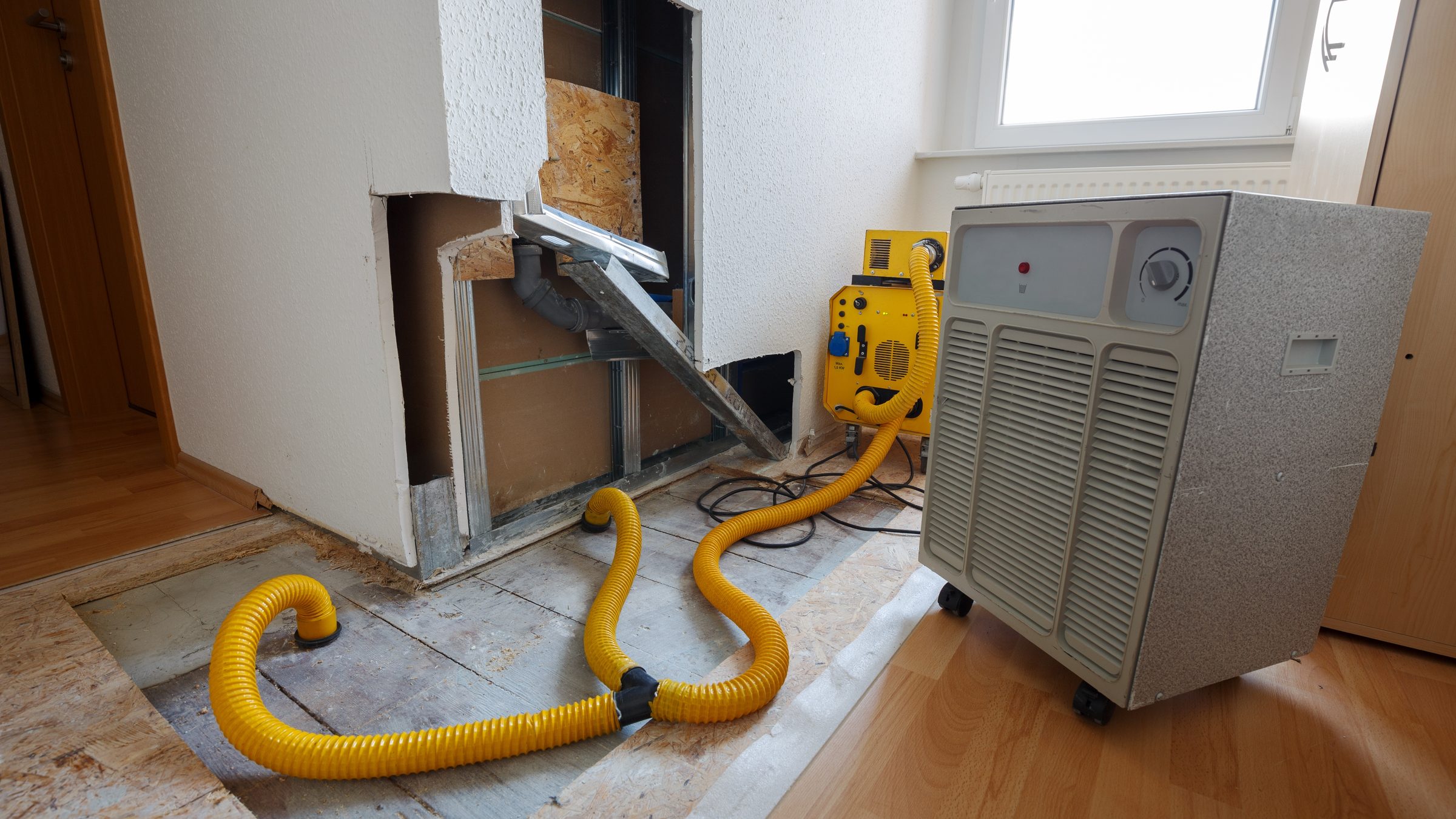
Drying and dehumidification
Air movers and dehumidifiers run to a target moisture content, monitored daily against the dry standard.
05
Cleaning and sanitizing
Affected contents and surfaces are cleaned, deodorized, and treated to stop secondary growth.
06
Restoration
Drywall, flooring, and finishes go back, and you get the full moisture log for your claim.
The clock started when the water did
What happens if you wait
Restoration is priced by how far the damage got, and damage is a function of time. This is the progression we see on almost every untreated water loss.
Minutes
Water finds every porous thing you own
It wicks up drywall, under flooring, and into subfloor and insulation. What you can see on the floor is a fraction of what is already wet.
1-24 hrs
Drywall swells, finishes bleed, odor starts
Furniture legs stain carpet. Laminate delaminates. Paper-faced drywall loses structural integrity and the first musty smell appears.
48-72 hrs
Mold begins to colonize
This is the line that changes the job. Past roughly 48 hours a drying job becomes a remediation job, and the cost and disruption both step up.
1 week +
Structural damage and health risk
Wood warps and swells, fasteners corrode, and spore counts climb. Restoration times and costs rise sharply, and some contents stop being salvageable.
Timelines describe typical residential water losses under normal indoor conditions. Category, temperature, humidity, and materials all shift them. An on-site inspection is the only way to know where your property sits.
What water damage restoration actually involves
Most people call us knowing something is wrong and not much else. Here is what the work is, what decides the cost, and where the real deadlines sit.
Water damage is not one problem. It is a sequence of them, and each one has a window. Miss a window and the next problem is larger, more expensive, and less likely to be covered.
The first hour is about stopping the loss, not fixing it
Before anyone arrives, two things matter more than anything a contractor does later: shut the water off at the main, and decide whether the power is safe to leave on. If water has reached outlets, a panel, or is running down inside a wall where wiring runs, the answer is no, and that is a call to the utility rather than to us.
Everything after that is triage. We are not trying to make the property look right on day one. We are trying to stop the water spreading into materials that are expensive to replace.
Category decides almost everything
The single question that changes the shape of a job is where the water came from.
- Category one is clean supply-line water — a burst pipe, a failed connector, an overflowing sink. Most materials can be dried in place.
- Category two is water that has picked up contamination — a washing machine discharge, a dishwasher, a toilet overflow without solids.
- Category three is grossly contaminated — sewage, a backed-up floor drain, or anything that has crossed ground or street. Porous materials come out rather than get dried, and everything remaining is decontaminated.
A category-one loss left for three days does not stay category one. Time degrades it, which is the real reason speed matters.
Drying is measured, not guessed
This is where most of the difference between contractors shows up, and it is almost invisible to the homeowner.
Air movers push evaporation. Dehumidifiers remove the moisture that evaporation puts into the air. Running fans without dehumidification pushes water vapour into wall cavities and subfloor, which is how a one-room loss becomes a remediation job six weeks later.
We meter affected materials daily against a dry standard — a target moisture content taken from unaffected material in the same building. Equipment comes out when the readings say so, not when the calendar does. You get the log.
Call us
24/7 rapid response
The form is fine for anything that can wait. If this is happening right now, call - a person answers, day or night, and you get a straight answer about whether it needs a truck tonight.
Answered 24 hours a day, 7 days a week
Where we work
Seven markets we cover
Response time is a function of where the truck starts, not where the office is. We keep crews close to every market we cover.
- Suffolk County
Suffolk runs from the Nassau line to Montauk, which means one crew can be pumping out a slab-on-grade ranch in Brentwood while another is tarping a roof on the East End.
- Rapid response teams on standby
- Licensed and insured
- Nassau County
Nassau is dense post-war housing stock with finished basements almost everywhere, which turns an ordinary supply-line failure into a full-floor loss.
- Rapid response teams on standby
- Licensed and insured
- Queens
Queens combines attached single-family stock with a very large stock of below-grade apartments, and Hurricane Ida made the consequences of that unmistakable.
- Rapid response teams on standby
- Licensed and insured
- Brooklyn
Brooklyn is party-wall territory — attached brownstones and row houses — and that changes the job.
- Rapid response teams on standby
- Licensed and insured
- Manhattan
Manhattan losses are vertical.
- Rapid response teams on standby
- Licensed and insured
- Staten Island
The East Shore between Midland Beach, New Dorp Beach, and Oakwood Beach took the worst residential losses of Hurricane Sandy anywhere in the city, and the recovery reshaped the housing stock.
- Rapid response teams on standby
- Licensed and insured
- Berkshire County
Berkshire County is a cold inland upland in western Massachusetts, and that inverts the loss pattern the rest of this company is built around: Pittsfield averages 22°F in January and roughly 150 days a year drop below freezing, so frozen and burst pipes rather than surge are what fills the winter schedule.
- Rapid response teams on standby
- Licensed and insured
More on water damage
Specific water damage problems
- Flood cleanup on Staten Island
Tidal surge, elevated houses and the Bluebelt, where floodwater is category three.
Read more - Sewage backup cleanup in Brooklyn
Combined sewers, heavy rain and basement apartments. Category three, handled properly.
Read more - Emergency water damage restoration
What happens in the first few hours, and what to do before the truck arrives.
Read more - Flooded basement cleanup on Long Island
Groundwater, sump failure and storm water in South Shore and North Shore basements.
Read more
FAQ
Water Damage questions, answered straight
If yours is not here, call and ask. You will get a straight answer, not a callback from a sales team.
How fast can you get here?
Will my homeowners insurance cover this?
How long does drying take?
What makes floodwater different from a burst pipe?
My basement floods every heavy rain. Is that restoration or a repair?
Can I just rent fans and dry it myself?
Services
Other services
Same team and the same single point of contact, whichever of these you are dealing with.
Fire & Smoke Damage Restoration
Board-up, soot and odor removal, contents cleaning, and rebuild, coordinated as one job instead of five vendors.
Learn more24/7 emergencyMold Remediation
Containment, HEPA filtration, and source repair, performed to New York State licensing requirements with third-party clearance.
Learn moreBy appointmentStorm Damage Restoration
Wind, hurricane, nor'easter and coastal surge damage for properties on the South Shore, the barrier islands, and the harbor edge.
Learn more24/7 emergencyBiohazard & Trauma Cleanup
Discreet, OSHA-compliant cleanup of trauma scenes, sewage, and other hazardous materials, in unmarked vehicles, handled by technicians trained for it.
Learn more24/7 emergencyAsbestos Abatement
Survey, containment, controlled removal and third-party clearance testing, filed and documented to New York State requirements.
Learn moreBy appointmentCommercial Restoration
Large-loss response for property managers, retail, healthcare, and multifamily, scoped around keeping you operating.
Learn more24/7 emergency
Crews are on standby right now
Crews are staged across Long Island and the five boroughs right now. Tell us what happened and we will tell you honestly whether it needs a truck tonight or an inspection tomorrow.
Answered by a person, 24/7· Rapid response teams on standby· We handle your insurance