
Nassau and Suffolk County
Mold Inspection, Long Island
We find the water that caused it, tell you honestly whether you need paid mold testing at all, and bring in an independent licensed mold assessor when New York says we have to.
- Clearance
- Third-party
- Phones answered
- 24/7
- Counties & boroughs
- 7
Certified & licensed · Fully insured · Documented to New York State requirements
Our certifications and credentials
IICRC Certified Technicians
Industry standard certification
OSHA Certified
Safety trained crews
25+ Years Experience
Ownership, in restoration
Licensed & Insured
Certificate on request
Local conditions
Why Long Island houses grow mold where they do
Long Island is two counties with one water problem and several different causes. The South Shore from Freeport and Island Park through Lindenhurst and Mastic floods on the tide cycle rather than on the rainfall, because the bay side comes up on a wind-driven high tide with no storm overhead at all. Inland, the island is finished basements on a high water table, so an ordinary supply-line failure becomes a full-floor loss, and much of Suffolk is still on cesspools and septic, which push category-three water back through floor drains once the leaching field saturates.
The consequence for mold work is that the growth is almost never where the homeowner is looking. Nassau and Suffolk are finished basements over a high water table, so the wall you can see is a stud bay with insulation behind it and the moisture is on the far side of both. Raised South Shore homes moved the living space up and left an unconditioned crawl space underneath, which from July through September holds enough humidity to start mold growth with no leak involved at all. Older properties on the North Shore add the concealed roof leak and the ice dam. Different causes, one thing in common: you find them with a meter, not with your eyes.
The soil does a lot of the work out here. Sandy, fast-draining ground across much of the island sits over a water table that rises with the season, so groundwater arrives at the slab rather than running off, and that is what starts the mold issues we see most. What people notice first is a musty odor rather than visible mold growth, usually in a room nobody uses. If somebody in the house has respiratory problems that clear up on holiday, that is worth mentioning on the call — mold exposure is difficult to reason about in the abstract and easy to test for in a specific building.
What we find behind a mold problem here, in order of frequency
- Finished basements over a high water table, with moisture behind the stud bay
- Unconditioned crawl spaces under raised South Shore homes
- Summer humidity alone, with no leak, in a closed-up basement
- Sump and supply-line failures in post-war housing stock
- Septic and cesspool backup through floor drains after a saturation event
- Concealed roof leaks and ice damming on older North Shore properties
- Condensation on uninsulated HVAC systems and duct runs in unconditioned space
None of that is fixed by killing the mold. Mold is what moisture leaves behind, so the useful half of an inspection is the half that finds the water. If the source is still running, the honest first call iswater damage restorationand structural drying, not testing. Leave it long enough and wet framing under that floor becomes a structural repair rather than a mold problem, and the two get fixed in a very different order.
Seasonality
Long Island mold has a calendar
Mold here is not random. Five patterns account for most of what we find, each with its own season, its own cause and its own tell. If you can place your problem on this table, you already know most of what an inspection is going to say.
| When | What is actually happening | How you can tell |
|---|---|---|
| Late spring | Groundwater rises with the water table, sumps run continuously, and the base of a basement wall stays damp. | A tide line low on the block or the slab edge, and a musty smell that comes back after rain. |
| July to September | Coastal humidity with no leak at all. Closed basements and unconditioned crawl spaces hold enough moisture to start growth on their own. | Growth on the underside of the subfloor, on stored cardboard, and on the cold side of duct runs. |
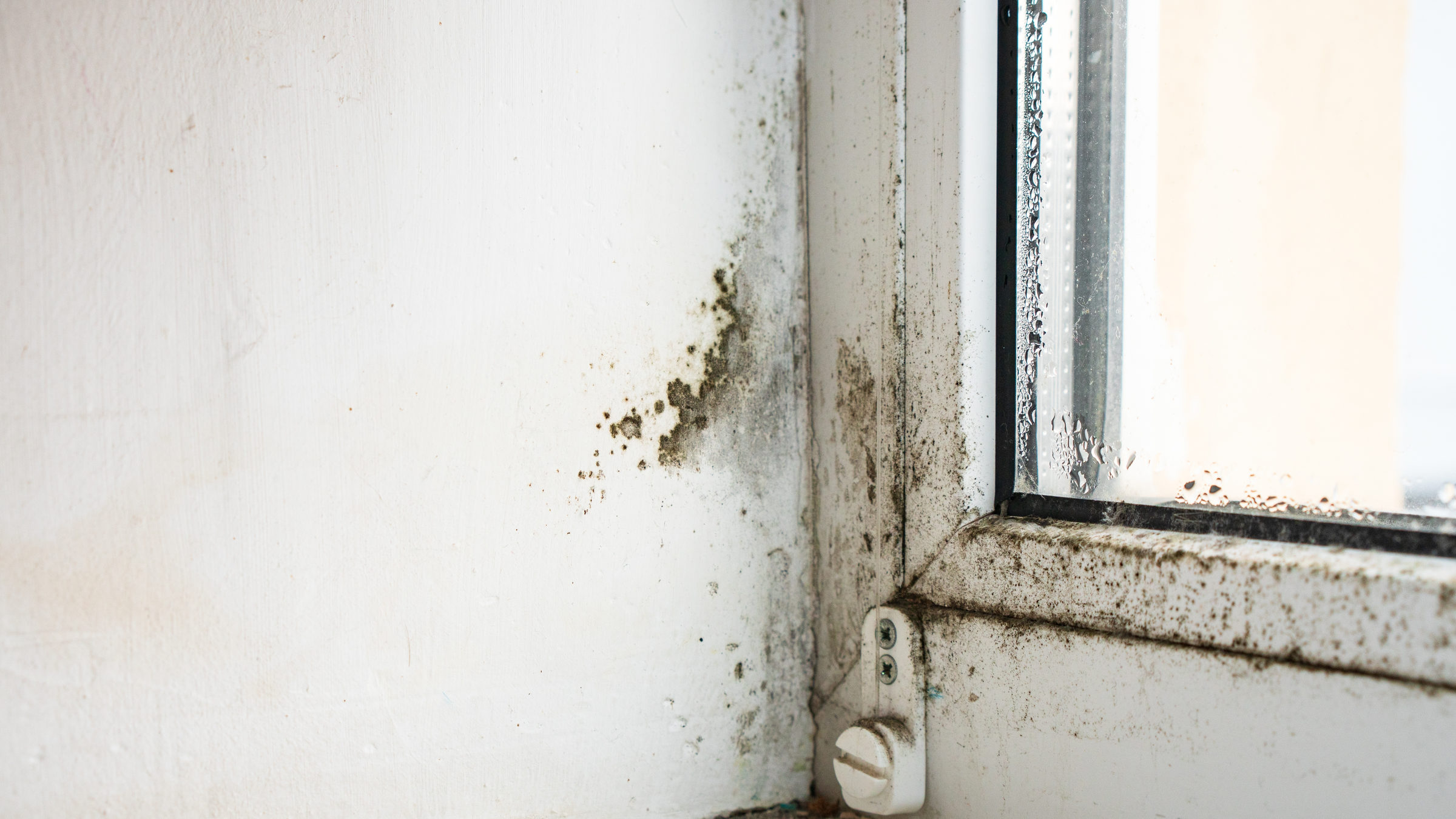
| First cold week | Warm indoor air meets cold exterior walls and condenses inside the cavity. | A black line along a window reveal or in the corner of a room on the weather side of the house. |
| Mid-winter | Ice damming on North Shore stock backs meltwater up under the shingles and into the top plate. | Staining at the ceiling line of an upstairs room, usually appearing during a thaw rather than during the storm. |
| After any nor’easter | Tidal and surge water on the South Shore and the barrier islands, which arrives on the tide cycle rather than with the rainfall. | Wet insulation and framing at the lowest level, and a mold problem four to six weeks later if it was never properly dried. |
Two of those five are not remediation jobs at all. Window-line condensation is a ventilation and insulation problem, and a humid crawl space is usually solved with a vapour barrier and dehumidification rather than demolition. A mold company that does not tell you that is selling you the only thing it sells.
Being able to place a problem on that calendar is what local expertise actually buys you: the first step is not to identify mold, it is to work out which season put the water there. Eliminate the moisture and you prevent mold growth without treating anything. Leave it and future mold growth is a certainty, not a risk. That is also why we take indoor air quality readings alongside the moisture map rather than instead of it — a spore count with no season and no source attached is a number, and practical solutions come from the other two.
New York law
New York licenses mold assessment and mold removal separately
This is the single most useful thing to understand before you hire anyone, and it explains why some Long Island companies will only test and others will only remove.
What Article 32 requires
Since January 2016, Article 32 of the New York Labor Law has required three separate licences from the State Department of Labor: a licensed mold assessor, who inspects and writes the remediation plan; amold remediation contractor, who performs the removal; and mold abatement workers. Different licences, different requirements, different people on site.
One firm cannot do both
The law prohibits the same company providing assessment and remediation on the same project. The rationale is a conflict-of-interest rule with an obvious logic: a company paid to find mold and paid again to remove it has an incentive to find a great deal of mold. It is also why the clearance test goes to someone who did not do the work.
Where the line falls
The licensing rules bite on projects covering more than about ten square feet. A homeowner working on their own residence is exempt in their own house. That exemption does not extend to a contractor you pay and it does not apply to rental property, which catches a lot of the two-family and summer-rental stock out here.
How we work inside that rule.We do the remediation. Formal mold assessment, the written plan and the post-remediation clearance test go to a New York licensed mold assessor who is independent of us — a professional we do not employ and do not pay for a result. We will arrange it, and you are free to appoint your own instead. We would rather you did than wonder about it. We do not clear our own work.
Once the assessment is written, the mold remediation process itself is not mysterious: containment, negative air so mold spores cannot reach the clean half of the house, removal of the porous material that cannot be cleaned, source repair, and clearance. The full sequence is on ourmold remediation servicespage. What changes from job to job is scale, not order — a bathroom ceiling and a whole finished basement get the same six steps with very different day counts.
Our process
How a mold inspection actually runs on Long Island
No step here is optional and none of them can be reordered. If a contractor skips one, ask which.
01
The initial consultation
What you can see, what it smells like, how long it has been there, and what happened before it appeared. A leak six months ago, or a wet spring, is the most useful sentence you can give us.
02
Start below the floor
On Long Island the answer is usually under the house. Finished basements, crawl spaces and unconditioned utility space are where the moisture sits, and that is where we start rather than in the room you called about.
03
Walk the water, not the mold
Visible mold growth is the symptom. We trace it back to the grading, the sump, the roof, the septic field, the plumbing leak or the summer humidity that put water there, because remediation without that repair is a redo.
04
Meter and map
Moisture meters on every affected surface and thermal imaging where a wall cavity, a subfloor or a crawl space is suspect. Water stains lie about their edges. A moisture meter does not.
05
Decide whether sampling earns its cost
If you can see it and smell it, air and surface sampling mostly confirms what you already know. It earns its cost when the source is hidden, when a health issue is involved, or when a sale or a claim needs a documented record.
06
Independent assessment where the law requires it
Formal mold assessment and the written remediation plan go to a New York licensed mold assessor who is not us. That separation is a legal requirement, not a preference.
07
Scope, remediate, clear
You get a written scope for the removal work with next steps in plain language. Containment, HEPA air filtration and source repair follow, and clearance testing goes back to the independent assessor.
Call us
Not sure whether you need mold testing at all?
Call and describe it. Mold does not need the same response a burst pipe does, but the water that caused it usually does, and we would rather tell you that on the phone than sell you a lab report you did not need.
Answered 24 hours a day, 7 days a week
Nassau and Suffolk
Two counties, two different mold problems
The island is one market for scheduling and two for diagnosis. Where you are changes what we expect to find before anyone opens the door, which is why the inspector asks for the cross street before they ask about the mold.
- Suffolk County
Great South Bay tidal surge and bay-side flooding. Septic and cesspool backup during saturation events.
Mold removal in Suffolk County - Nassau County
Finished-basement losses from sump and supply-line failure. South Shore canal and bay-side tidal flooding.
Mold removal in Nassau County - Berkshire County
Frozen and burst pipes during arctic outbreaks. Unoccupied seasonal homes where a winter failure runs undiscovered.
Mold removal in Berkshire County
What you get at the end is a detailed report rather than a verdict: a named source, moisture readings at identified points, photographs, the extent in square feet, and actionable recommendations you can hand to a plumber, a roofer or an adjuster. Where the case needs it, the independent assessor writes the remediation plan on top of that, and a complex remediation plan on a large finished basement reads very differently from a page and a half on a bathroom ceiling.
One boundary worth stating plainly. Several Long Island inspection firms bundle mold with lead and asbestos testing. We do not offer those — asbestos testing and lead testing are a different trade with a different accreditation, and we would rather point you at somebody who does them properly. What we do offer alongside mold isasbestos abatementonce material has already been identified by somebody else.
Commercial buildings, schools and multi-tenant property in the Long Island area and nearby areas are handled the same way, with the survey and the clearance scheduled around occupancy rather than around us.
Crawl space under a raised South Shore home. Most of what we find out here is overhead, on the underside of the subfloor, where nobody has any reason to look.
Coverage
Towns we cover for mold inspection on Long Island
Crews local to Nassau and Suffolk, so the inspector who walks your property knows the housing stock and the water table on your street rather than driving in from the city.
- Babylon
- Baldwin
- Bay Shore
- Bellmore
- Bethpage
- Brentwood
- Commack
- Deer Park
- East Hampton
- East Meadow
- Franklin Square
- Freeport
- Garden City
- Glen Cove
- Great Neck
- Hauppauge
- Hempstead
- Hicksville
- Holbrook
- Holtsville
- Huntington
- Island Park
- Islip
- Levittown
- Lindenhurst
- Long Beach
- Manhasset
- Massapequa
- Mastic
- Medford
- Melville
- Merrick
- Mineola
- Nesconset
- North Babylon
- Oceanside
- Patchogue
- Plainview
- Port Jefferson
- Port Washington
- Riverhead
- Rockville Centre
- Ronkonkoma
- Sayville
- Smithtown
- Syosset
- Valley Stream
- Wantagh
- West Islip
- Westbury
- Westhampton
Do not see your town? We almost certainly still cover it —ask us.
FAQ
Mold inspection questions from Long Island homeowners
If yours is not here, call and ask. You will get a straight answer, not a callback from a sales team.
Do I need a mold inspection before buying a house on Long Island?
Why will you not give me a mold inspection price over the phone?
My crawl space smells musty but I cannot see any mold. What now?
Is mold worse in a finished basement than an unfinished one?
Our cesspool or septic backed up into the basement. Is that a mold job?
How long does a mold inspection take?
Related restoration work on Long Island
Inspection tells you what you have. These are the jobs that follow from it, and the water problems that cause it in the first place.
- Mold removal in Nassau CountyContainment, removal, source repair and independent clearance across Nassau.
- Mold removal in Suffolk CountyThe same work across Suffolk, from the Nassau line to the East End.
- Flooded basement cleanupThe first 48 hours after a basement takes water, which is when mold is still preventable.
- Basement mold removalThe guide version: why it grows, what comes out, and what stops it coming back.
- Attic mold removalRoof sheathing, ventilation and the ice-dam pattern on North Shore stock.
- All restoration services on Long IslandWater, fire, storm and biohazard work across Nassau and Suffolk.
Get a straight answer about the mold in your house
Describe what you can see and smell and how long it has been there. We will tell you whether this needs an inspection, a plumber, or nothing at all, before anyone quotes you for removal.
Answered by a person, 24/7