
Five boroughs · emergency service, 24/7
Fire Damage Restoration, New York City
Board-up tonight, firefighting water out before the soot work starts, and every unit the smoke reached checked rather than only the one that burned. Crews across Brooklyn, Queens, Manhattan and Staten Island.
- Rapid response teams
- On standby
- Phones answered
- 24/7
- Counties & boroughs
- 7
Certified & licensed · Fully insured · We handle your insurance
Our certifications and credentials
IICRC Certified Technicians
Industry standard certification
OSHA Certified
Safety trained crews
25+ Years Experience
Ownership, in restoration
Licensed & Insured
Certificate on request
Local conditions
A New York City fire is almost never one apartment’s problem
New York City fails in three ways that the rest of the region does not. People live below grade here in numbers no other market matches, so a cloudburst is a life-safety event before it is a property loss. Most of the city is on a combined sewer, which means rain and sewage share one pipe and a storm that outruns its capacity comes back up through the lowest fixture in the building rather than in through the door. And the housing stock goes up rather than out, so a failed riser or supply line on a high floor is a claim on every floor beneath it before anyone has found the shutoff.
The same density that shapes every water loss in this city shapes the fire ones. Buildings here are attached, stacked, and connected to each other by shafts and shared framing that nobody thinks about until something burns. So a fire in one unit generates a fire claim, several smoke claims, and a water damage claim in the apartments below, frequently against three different policies at once.
That is the practical difference between fire damage restoration in New York City and the same work anywhere else in the region. The burned unit is usually the easiest part of the job to price. What takes the judgement is finding every place the smoke went, proving which loss belongs to which policy, and getting equipment and crews into a building that was not designed to have either. A pre-war line on the Upper East Side, a Ridgewood two-family and a Todt Hill detached house are three different jobs with the same fire in them.
The five ways a fire spreads past the unit it started in
Firefighting water goes down
FDNY puts water in at volume and gravity does the rest. It runs through floor assemblies into every unit below and usually finishes in the cellar. On a lot of city jobs the water loss is larger and more expensive than the burn.
Shafts and chases carry smoke up
Pre-war stock is full of light wells, dumbwaiter shafts, and plumbing and steam chases that connect floors to each other. Smoke uses all of them, and it will reach the top floor of a building whose fire was on three.
Party walls and shared joists
Attached row houses and semi-detached stock in Brooklyn, Queens and Staten Island share framing bays. Smoke and heat travel inside the cavity, which is why the neighbour with no visible damage still has a claim.
Ductwork redistributes it
An HVAC system that was running during the fire pulls smoke into rooms nothing was burning in and leaves residue in the ducts. It then reactivates on the first warm humid day, weeks after everything looked finished.
The corridor is a shared surface
The public hallway, the elevator lobby, the stair and the carpet all take smoke, and in a co-op or condo those are common elements. Which means the building has a claim of its own running alongside yours.
Before we arrive
What to do, and what not to touch
Four of the six below are things not to do. That is not us being precious about the work — soot is one of the few materials where a well-meant first attempt reliably makes the job bigger and more expensive than leaving it alone.
Do not go back in until it is released
FDNY releases the property, and the Department of Buildings can post a vacate order separately. Structure, gas and electrical have to be cleared before anybody is inside, including to collect belongings.
Do not run the HVAC
If the system was running during the fire it has soot in it. Switching it back on distributes that soot into the rooms that were still clean, and it is the single most common way a two-room loss becomes a whole-apartment loss.
Do not wipe the walls
Dry soot lifts off with a dry sponge and smears permanently with a wet cloth. One pass with a damp rag can convert a wall that could have been cleaned into one that has to be sealed and repainted. It is the rare job where waiting for a professional genuinely costs you less than starting.
Photograph everything first
Wide shots of every room, then close-ups. Include the units and rooms the fire did not reach but the smoke did, because that is the damage adjusters most often miss.
Discard nothing except food and medication
Throw out food, medication and cosmetics that were exposed. Everything else stays where it is until it has been photographed and listed, because the adjuster prices what is physically there.
Put the managing agent on notice
In a co-op or condo, your policy and the building’s both have a role, and where the line falls is set by the proprietary lease or the offering plan rather than by common sense. Get it in writing early.
Smoke residue
Four kinds of soot, and why the difference decides the bill
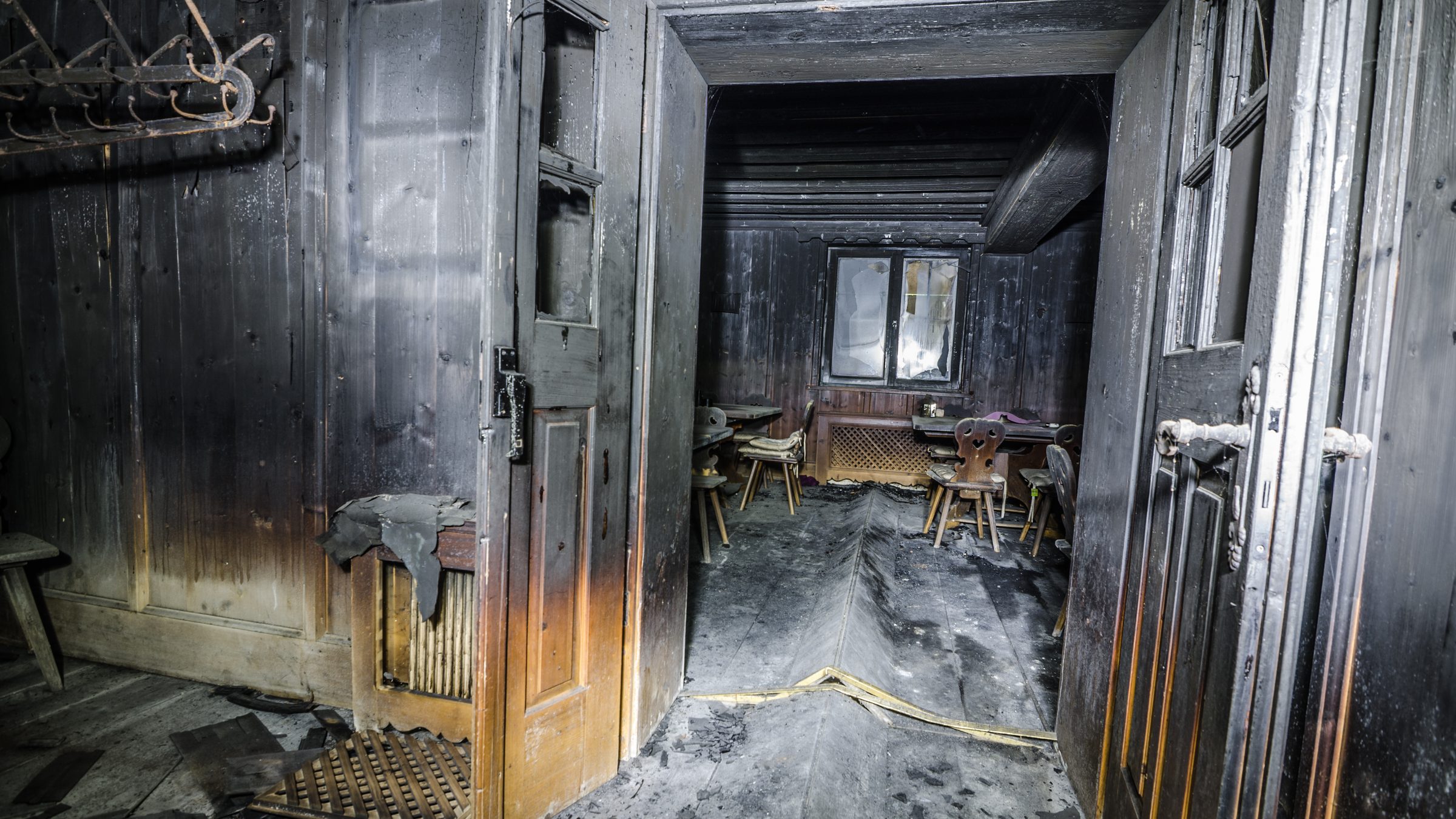
There is no general-purpose soot cleaner, and the people selling one are the reason so many walls get sealed and repainted that did not need to be. What burned determines the residue, and the residue determines the chemistry, the order of operations, and whether the surface survives.
| Residue | What made it | How it behaves | How it comes off |
|---|---|---|---|
| Dry soot | A fast, hot, well-fed fire. Paper, wood, natural fibres. | Fine and powdery. Sits on top of surfaces rather than bonding to them, and travels a long way on air currents. | Dry sponges and HEPA vacuuming first, every time. Wet-cleaning it on the first pass smears carbon into paint and plaster and turns a cleanable wall into a repaint. |
| Wet soot | A slow, smouldering, oxygen-starved fire. Plastics, foam, rubber, synthetics. | Sticky, smeary and dense, with the sharpest odor of the four. Bonds to whatever it lands on. | Degreasing agents and repeat passes. Some substrates never come clean and the honest call is to remove and replace them rather than bill for a fourth attempt. |
| Protein residue | A kitchen fire. Food left on a burner, usually with no flame spread at all. | Nearly invisible - a thin amber film that yellows paint, varnish and cabinet finishes. The odor is severe and completely out of proportion to what you can see. | Found by smell rather than by eye, then cleaned enzymatically. Frequently needs sealing and repainting because the film has already discoloured the finish. |
| Fuel-oil soot | A boiler or furnace misfire. A puff back, with no fire anywhere. | A fine oily black film distributed through the whole apartment by the heating system, so it reaches rooms nothing was ever burning in. | Different job, different insurance conversation, and it is covered on its own page. See puff back cleanup. |
Acidic soot is also the reason none of this waits. It keeps working while you decide what to do — etching glass, pitting chrome and aluminium, corroding appliance contacts and discolouring grout — and it does most of that physical damage in the first days rather than over months. That is why fire damage cleanup is priced as emergency work even when the fire itself has been out since Tuesday, and why a week of waiting for an insurance company to appoint someone causes further damage that nobody budgeted for.
If what you have is a fine black film over an entire apartment with no fire anywhere, that is a boiler misfire rather than a fire loss.Puff back cleanupcovers that job specifically, and the insurance conversation for it is a different one. If the fire itself was small but the smell is everywhere,smoke damage repairis the closer match.
Scope
What fire damage restoration services actually cover
What gets searched for as fire damage restoration NYC is almost never one trade. It is six of them running in a fixed order, and the order is not negotiable — which is why one company holding the whole fire damage restoration process is worth more here than the cheapest price on any single line of it.
Emergency board up and make-safe
Board up services on broken windows and doors, tarping over a breached roof, and the property left secure against weather and against the street. This is emergency restoration in the literal sense: it stops the loss growing, and it happens before anyone estimates anything.
The water damage inside the fire claim
Firefighting water is its own loss. Extraction, then structural drying measured on a moisture meter rather than judged by hand, and if it has been sitting long enough, mold remediation on top. Skipping this is how a fire job turns into a mold job in week six.
Structural cleaning and soot removal
Walls, ceilings, framing and the cavity behind them. Structural cleaning is where most of the labour on a fire damaged home goes, and it is the part that decides how much reconstruction you end up paying for.
Contents cleaning
Furniture, textiles, window treatments and light fixtures each clean differently, and soot collects in fixtures and shades long after the room reads as finished. Everything is inventoried and photographed at the initial inspection, before anything moves, because that list is what the adjuster prices.
Odor removal after fire
Smoke and soot leave odor in insulation, wall cavities and ductwork. Those get treated at the source, then hydroxyl or ozone finishes it. Where the ducts themselves are the reservoir, that is a duct specialist’s job and we will say so rather than pretend a fogger reaches into a riser.
Reconstruction, and the claim behind it
One project manager carries the job from board-up through final repair. The insurance company gets photographs, moisture readings and a line-item scope in the format the insurance claim process expects, so the argument is about numbers rather than about whether the damage existed.
The one honest caveat: not every fire damaged property is restorable, and a company that tells you otherwise on the phone is guessing. Where charring has gone into structural members, or the building stood open to weather for weeks, the answer is a total loss and a rebuild rather than an attempt to restore what is there. We would rather say that on day one than bill you for three weeks of cleaning first.
Our process
How fire damage restoration actually runs in the city
No step here is optional and none of them can be reordered. If a contractor skips one, ask which.
01
We start when the building is released
Nothing goes in until FDNY hands the property back, and in New York the Department of Buildings can post a vacate order on top of that. Structure, gas and electrical get cleared first. That applies to you as well as to us, and it is the part people argue with most.
02
Board-up and weather protection the same day
Open windows, a breached roof or a burned-out storefront on a dense block invites the next loss before the first one is settled. Emergency board up and tarping go in immediately so weather and theft do not stack on top of the fire.
03
Extract the firefighting water first
A truck operation puts a lot of water into a building in a short time and most of it ends up below the fire. It gets extracted and the structure dried before any soot work starts, because water and soot together make a slurry that drives residue into plaster instead of lifting it off.
04
Map how far the smoke actually went
Every unit that shares a shaft, a party wall or a duct run with the fire apartment gets checked, not only the ones that smell on day one. In pre-war stock the smoke has usually reached further than the water did.
05
Match the cleaning to the residue
Dry soot, wet soot, protein residue and fuel-oil film each need a different chemistry and a different order of operations. Using the wrong one sets the stain permanently, which is why the first pass on a wall decides whether it can be cleaned or has to be painted.
06
Treat the odor at its source, then rebuild
Smoke odor lives in ductwork, insulation and wall cavities, not on the surfaces you can see. Those get addressed, then hydroxyl or ozone treatment neutralizes what is left, and reconstruction returns the space as part of the same job rather than a second contract.
Call us
Fire in the building tonight?
Call. A person answers, day or night, and you will get a straight answer about what has to happen before anybody can be inside and what we can start on tonight.
Answered 24 hours a day, 7 days a week
Four policies, one fire, and nobody agreeing about the line
Outside the city a fire is usually one building, one owner, one policy. Here a single unit fire can put four policies in play at once, and the boundary between them is set by documents rather than by walls. Working out which is which is a first-week job, not a last-week one.
Renters. Your contents and your additional living expenses while the unit is uninhabitable. Not the building. The living-expense cover is the part tenants most often leave unclaimed, so keep every receipt from the night of the fire onward.
Co-op shareholder. Where the building’s responsibility stops and yours starts is written in the proprietary lease and the offering plan, not in the drywall. Whether the policy is wall-in or wall-out changes who pays for fixtures, floors and cabinetry.
Condo unit owner. The same question in different language: whether the master policy is bare-walls or all-in. Two buildings on the same street can answer it differently, so the document decides it, not the industry norm.
Building or landlord. Covers the structure and the common elements, which after a fire means the corridor, the stair, the lobby and the elevator. That claim runs alongside yours rather than instead of it.
We document with photographs, moisture readings on the water portion and a line-item scope in the format adjusters expect, and we bill most carriers directly. The claim stays yours. What we can do is make sure the smoke damage in the unit two floors up is on the record from the first visit, because a loss nobody documented in week one is very hard to add in week six. More onhow we handle insurance claims.
Dry sponge, first pass, before anything wet touches the wall. On plaster this is the step that decides whether the surface gets cleaned or repainted, and it cannot be done twice.
Coverage
Fire and smoke damage restoration, borough by borough
The work is the same in all four. What changes is the building around it, and that is most of what decides how long a job takes here. Fire restoration, smoke damage cleanup and the rebuild that follows run out of the same emergency services line in every borough, residential and business alike — a ground-floor storefront in Queens, NY and the apartment above it are one job, not two.
- QueensAttached single-family stock and a very large stock of below-grade apartments, so a fire on the ground floor is a smoke and water loss in the unit underneath it.Fire and smoke work in Queens
- BrooklynParty-wall territory. Smoke and heat travel the shared joist bays between brownstones, and cellar-level retail takes the firefighting water.Fire and smoke work in Brooklyn
- ManhattanVertical losses and building politics. Certificates of insurance, approved work hours and a service elevator reservation are part of the scope, not an afterthought.Fire and smoke work in Manhattan
- Staten IslandThe most detached, lowest-density housing stock in the city, and the only borough where a fire crew can usually work off the street without a shed or a permit conversation.Fire and smoke work in Staten Island
Outside the five boroughs we also cover Nassau and Suffolk —Long Island restorationruns off a separate line.
FAQ
Fire and smoke damage questions from New York City
If yours is not here, call and ask. You will get a straight answer, not a callback from a sales team.
Can a fire-damaged house be restored?
How long does fire damage restoration take?
What is considered smoke damage?
What should I throw away after smoke damage?
Does renters insurance cover smoke damage?
The fire was in another apartment. Why does my unit smell of smoke?
Why does the smoke smell come back weeks later?
How much does fire damage restoration cost in NYC?
Related fire and smoke damage work
This page is the city-wide view. These cover the same work at the borough level, the two soot jobs that are not fire losses, and the water side of what a fire leaves behind.
- Fire & smoke damage restorationThe full service: board-up, soot chemistry, odor treatment and rebuild.
- Smoke damage repairWhen the fire was small and the smell is the whole problem.
- Puff back cleanupFine oily soot from a boiler misfire, with no fire involved at all.
- Restoration across NYCThe city hub: water, mold, fire and flood across the four boroughs.
- Insurance claimsWhat adjusters actually want, and what to document before anything moves.
- Talk to a personTwo lines, both answered 24 hours a day, including holidays.
Soot keeps working while you decide
It is acidic, it etches metal and glass, and it does most of that damage in the first few days. Tell us what burned, how far the smoke went, and which floor you are on, and we will tell you honestly what this needs.
Answered by a person, 24/7· Rapid response teams on standby· We handle your insurance