
Queens, New York City
Mold Inspection, Queens
We find the water that caused it, tell you honestly whether you need paid mold testing at all, and bring in an independent licensed mold assessor when New York says we have to.
- Clearance
- Third-party
- Phones answered
- 24/7
- Counties & boroughs
- 7
Certified & licensed · Fully insured · Documented to New York State requirements
Our certifications and credentials
IICRC Certified Technicians
Industry standard certification
OSHA Certified
Safety trained crews
25+ Years Experience
Ownership, in restoration
Licensed & Insured
Certificate on request
Local conditions
Why Queens homes grow mold where they do
Queens combines attached single-family stock with a very large stock of below-grade apartments, and Hurricane Ida made the consequences of that unmistakable. Southern Queens along Howard Beach, Broad Channel, and the Rockaways floods tidally and took catastrophic surge damage in Sandy. Interior neighborhoods flood differently: the sewer system is combined in much of the borough, so a cloudburst that outpaces capacity backs up through floor drains and basement fixtures rather than coming in the door.
That is the whole Queens mold story in one paragraph. Ida in September 2021 was the demonstration: the water came up through floor drains and basement fixtures rather than in through the door, and the mold problems arrived six weeks later in below-grade apartments that had been pumped out and left to dry on their own. Southern Queens along Howard Beach, Broad Channel and the Rockaways adds tidal flooding and salt water to the same pattern. And in the attached single-family stock across Ridgewood, Woodhaven and Middle Village, water in one house does not stay in one house — it tracks along the shared joist bay, which is why we meter the neighbours before anyone quotes a scope.
What we find behind a mold problem here, in order of frequency
- Combined-sewer backup through basement floor drains after a cloudburst
- Below-grade apartments and cellars with no dehumidification through the summer
- Hydrostatic pressure through the base of a foundation wall
- Long-running plumbing leaks inside a wall cavity, found by a stain months later
- Party-wall and shared-joist migration in attached houses
- Condensation on cold exterior walls and uninsulated HVAC system ductwork
- Tidal and surge water in Howard Beach, Broad Channel and the Rockaways
We serve the whole Queens area the same way, and a commercial property is not a different problem, only a bigger one: a restaurant cellar in Astoria and a two-family house in Woodhaven both grow mold because of moisture buildup nobody measured. What people notice first is usually not growth at all — it is mildew on a stored box, a smell, or a health complaint that comes and goes. Any of those is enough to justify a phone call.
None of that is fixed by killing the mold. Mold is what moisture leaves behind, so the useful half of an inspection is the half that finds the water. If the source is still running, the honest first call iswater damage restorationand structural drying, not testing. Leave standing water long enough and the wet framing behind that wall becomes a structural integrity problem rather than a mold problem, and the two get repaired in a very different order.
New York law
The company that finds the mold is not allowed to remove it
This is the single most useful thing to understand before you hire anyone in Queens, and almost none of the mold remediation companies advertising here put it on their website.
Three licences, not one
Since January 2016, Article 32 of the New York Labor Law has required three separate licences issued by the State Department of Labor: a licensed mold assessor, who inspects and writes the remediation plan; amold remediation contractor, who performs the removal; and mold abatement workers, who do the hands-on work. Different licences, different requirements, different people.
Why they are kept apart
The law prohibits one company holding both the assessment and the remediation role on the same project. The rationale is plain: whoever gets paid to find the problem should not also be paid to remove it, and whoever performed the removal should not be the one certifying that it passed. That is why the clearance test at the end goes to an independent assessor.
Where the line falls
The licensing rules bite on projects covering more than about ten square feet. A homeowner working on their own residence is exempt and can do what they like in their own house. The exemption does not extend to a contractor you pay and it does not apply to rental property, which matters in a borough with this much two-family and below-grade rental stock.
So when a Queens mold company offers to test and remediate under one contract, they are either working under the ten-square-foot threshold, working on an owner-occupied house where the exemption applies, or hoping you will not ask. It is a fair question and any honest company answers it in one sentence. Landlords and property managers hit the same rule from the other direction: they want one invoice for the whole job, and the law will not give them one.
How we work inside that rule.We do the remediation. Formal mold assessment, the written plan and the post-remediation clearance test go to a New York licensed mold assessor who is independent of us — a professional we do not employ and do not pay for a result. We will arrange it, and you are free to appoint your own instead. We would rather you did than wonder about it. We do not clear our own work.
Once the assessment is written, the mold remediation process itself is not mysterious: containment, negative air so spores cannot spread from the work area into clean parts of the house, removal of the porous material that cannot be cleaned, source repair, and clearance. The full sequence is set out on ourmold remediation servicespage, and the Queens-specific version of the removal work lives on themold removal in Queenspage. What changes from job to job is scale, not order.
Our process
How a mold inspection actually runs in Queens
No step here is optional and none of them can be reordered. If a contractor skips one, ask which.
01
The call
What you can see, what it smells like, how long it has been there, and what the weather was doing when it appeared. A cloudburst last September is the most useful sentence you can give us.
02
Start at the lowest point
In Queens that is almost always the below-grade level. We check the floor drain, the base of the walls and the mechanical room before we look at the room you called about, because water finds the bottom of the building first.
03
Walk the water, not the mold
Visible mold growth is the symptom. We trace it back to the sewer backup, the roof, the grading, the plumbing leak or the condensation that put water there, because remediation without that repair is a redo.
04
Meter and map
Moisture meters on every affected surface and thermal imaging where a wall cavity, a shared party wall or a subfloor is suspect. Water stains lie about their edges. A moisture meter does not.
05
Decide whether sampling earns its cost
If you can see it and smell it, air and surface samples mostly confirm what you already know. Testing earns its cost when the source is hidden, when someone in the house is symptomatic, or when a sale or a claim needs a documented record.
06
Independent assessment where the law requires it
Formal mold assessment and the written remediation plan go to a New York licensed mold assessor who is not us. That separation is a legal requirement, not a preference.
07
Scope, remediate, clear
You get a written scope for the removal work. Containment, HEPA air filtration and source repair follow, and post-remediation clearance testing goes back to the independent assessor.
Call us
Not sure whether you need mold testing at all?
Give us a call and describe it. Mold does not need the same response a burst pipe does, but the water behind it usually does, and we would rather tell you that on the phone than sell you a lab report you did not need.
Answered 24 hours a day, 7 days a week
What we find
Where mold hides in a Queens house, and what it means
The location of the growth tells you more than the colour of it does. Here is what each of the five common findings usually means about the water behind it, which is the part that decides what the repair costs.
| Where we find mold | What it looks like | What it usually means |
|---|---|---|
| Below-grade apartment or cellar | Dark growth low on the walls, a musty odor that never clears, lifting vinyl or carpet. | Hydrostatic pressure, floor-drain backflow, or summer humidity with no dehumidification. |
| Behind a kitchen or bathroom wall | A stain, a soft spot or bubbling paint, often with no visible mold at all. | A supply or waste line that has been weeping inside the cavity for months. |
| Attached party wall | Growth stopping abruptly at a stud line, or appearing on your side after the neighbour had work done. | Water tracking along a shared joist bay from the property next door. |
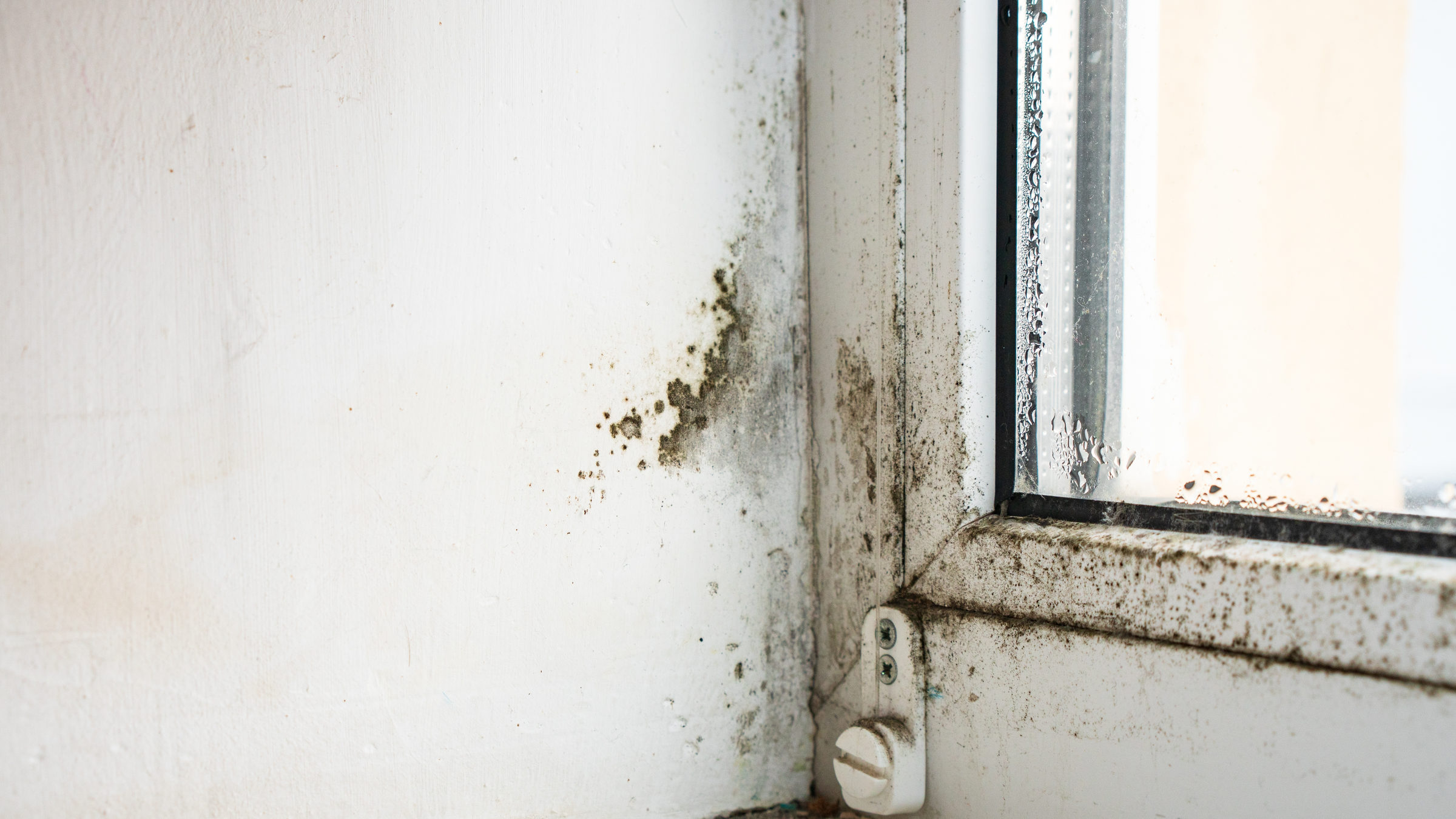
| Around windows and exterior corners | A black line along the reveal, worst in January, gone by May. | Condensation on cold masonry. This is a ventilation and insulation problem, not a leak. |
| HVAC system and ductwork | Nothing visible. The smell arrives with the air handler and reaches rooms with no water in them. | A wet coil, a blocked condensate line, or return ducting run through a damp space. |
Every one of those five has the same root cause behind it: water arriving faster than the building can dry. You cannot eliminate mold from a building by treating the surface, and professional mold remediation that does not correct the source is a maintenance subscription. What protects the property is fixing the water, and the presence or absence of a documented moisture source is the difference between a job that is finished and one that recurs.
Black mold gets the headlines, and colour is close to useless as a diagnostic. Several species present as black, some of the more allergenic ones are not black at all, and the species almost never changes the removal method. What changes the method is the material: non-porous surfaces clean, porous material comes out. Treat any significant indoor mold growth seriously and fix the moisture, whatever colour it is.
Mold testing
When mold testing earns its cost, and when it does not
Mold testing services are sold as one thing and are really several different things, each answering a different question. These are the five situations where sampling tells you something a walkthrough cannot, and one where it mostly does not.
A smell with no visible mold
Air quality testing compares indoor airborne spore counts to an outdoor control, which is how you find growth you cannot see.
Somebody is symptomatic
When respiratory issues or an allergic reaction track with being in the building, a documented indoor air quality baseline is worth having.
A sale or a purchase
A dated report with photographs and moisture readings is the document that keeps a mold finding from becoming a negotiation.
A landlord or a claim
Third party lab analysis is far harder to argue with than a phone call, and it survives a conversation with an adjuster.
After the removal work
Post-remediation clearance testing is the document that closes the job, and it has to come from someone who did not do the work.
Visible growth, obvious cause
Here sampling mostly confirms what you already know. Spend the money on the removal and the repair instead.
Containment and HEPA air filtration on a basement job. The barrier is not theatre — without negative air, removal pushes mold spores into the clean half of the house.
Coverage
Neighborhoods we cover for mold inspection in Queens
Crews local to the borough, so the inspector who walks your property works these streets routinely rather than driving in from another county.
- Astoria
- Bayside
- Broad Channel
- Corona
- Elmhurst
- Flushing
- Forest Hills
- Fresh Meadows
- Glendale
- Howard Beach
- Jackson Heights
- Jamaica
- Long Island City
- Maspeth
- Middle Village
- Ozone Park
- Rego Park
- Ridgewood
- Rockaway Beach
- Sunnyside
- Whitestone
- Woodhaven
- Woodside
Do not see your town? We almost certainly still cover it —ask us.
FAQ
Mold inspection questions from Queens homeowners
If yours is not here, call and ask. You will get a straight answer, not a callback from a sales team.
Are mold inspections worth it?
Why does mold keep coming back in my basement apartment?
What kills mold permanently, and what only makes it look gone?
How do I know if there is mold behind the wall?
My basement flooded during Ida and there is mold now. Will insurance cover it?
How long does mold remediation take from start to finish?
Related restoration work in Queens
Inspection tells you what you have. These are the jobs that follow from it, and the water problems that cause it in the first place.
- Mold removal in QueensThe remediation itself: containment, removal, source repair and independent clearance.
- Water damage restorationExtraction and structural drying before a wet building becomes a mold problem.
- Storm and flood damageCloudburst sewer backup, Jamaica Bay surge, and the category-three water that follows.
- Basement and cellar moldThe below-grade version of this problem, which is most of what we see here.
- Mold inspection across NYCCost structure, Local Law 55 and what a report has to contain.
- Talk to a personTwo lines, answered 24 hours a day, including holidays.
Get a straight answer about the mold in your house
Describe what you can see and smell and how long it has been there. We will tell you whether this needs an inspection, a plumber, or nothing at all, before anyone quotes you for removal.
Answered by a person, 24/7