
Staten Island · emergency service, 24/7
Flood Cleanup, Staten Island
Standing water out tonight, floodwater treated as contaminated until proved otherwise, and the structure dried to a moisture meter reading. Crews across the East Shore, the South Shore and the North Shore.
- Rapid response teams
- On standby
- Phones answered
- 24/7
- Counties & boroughs
- 7
Certified & licensed · Fully insured · We handle your insurance
Our certifications and credentials
IICRC Certified Technicians
Industry standard certification
OSHA Certified
Safety trained crews
25+ Years Experience
Ownership, in restoration
Licensed & Insured
Certificate on request
Local conditions
Staten Island does not flood the way the rest of the city floods
The East Shore between Midland Beach, New Dorp Beach, and Oakwood Beach took the worst residential losses of Hurricane Sandy anywhere in the city, and the recovery reshaped the housing stock. Many homes here are now elevated, which changes where water goes and which utilities are exposed. The Bluebelt system handles stormwater across the South Shore effectively in ordinary rain and is simply overwhelmed in extreme events. Interior neighborhoods sit on clay soils that shed water toward foundations rather than absorbing it.
That is the practical difference. In Manhattan and most of Brooklyn a flood is a below-grade event in a building that goes upward. Here it is a ground-floor event in detached and semi-detached houses on a shoreline that has already been through the worst of it once, and a large share of the residential building stock on the East Shore has been physically altered because of that.
Which means flood cleanup on this borough is rarely a pump-and-dry job. It is a contamination call, a demolition scope and a drying plan, usually with an insurance question underneath it that nobody warned the property owners about when they bought the house.
The four ways water arrives here
Tidal surge on the East Shore
Midland Beach, New Dorp Beach, Oakwood Beach and South Beach sit low against the Lower Bay. Water arrives on the tide cycle rather than on the rainfall, which is why a clear sky overhead tells you nothing, and it brings the street in with it.
The Bluebelt at capacity
The engineered wetlands and stream corridors across the South Shore move an enormous amount of stormwater in ordinary rain and are simply overwhelmed in an extreme event. When that happens the water backs up into the low-lying streets those corridors drain, which is not a failure of the system so much as the edge of it.
Clay soil pushing back at the foundation
Inland — Todt Hill, New Springville, Bulls Head — the soils shed water toward buildings rather than absorbing it. That is hydrostatic pressure against a foundation wall, and it comes through the cold joint where the floor meets the wall with nothing broken at all.
Combined-sewer surcharge on the older North Shore
St. George, Stapleton, Port Richmond and West Brighton carry older combined sewer infrastructure, so a cloudburst that outruns the pipe comes back up through the lowest fixture in the house. That is category three water the moment it arrives, and it has nothing to do with the tide.
Raised houses
What lifting the house changed, and what it did not
A great many East Shore homes were raised after Sandy, and elevation works: it is the single most effective thing a homeowner on this shoreline can do. But it moves the problem rather than deleting it, and the flood cleanup on a raised house is a different job from the one on the same house before it went up.
The underside is now the exposed floor
Everything that used to be inside a basement — the boiler, the water heater, the electrical panel, the ductwork, the plumbing runs — is now in an open or semi-enclosed space under the floor frame. Water reaches all of it without ever touching your living space, and the batt insulation between the floor joists holds it afterwards.
Silt and salt stay behind
Surge does not simply drain away from an underfloor space. It leaves silt in the framing bays and salt in every porous material it touched, and salt keeps pulling humidity in long after the water is gone. Rinsing before drying is the step that prevents a wall reading dry in winter and damp in July.
Flood vents do their job, and that job is not keeping water out
Vents in an enclosure below the lowest floor exist to let water in and out so hydrostatic pressure does not take the foundation with it. Working exactly as designed, they mean the enclosure floods. A finished, converted or heavily stored enclosure is therefore a loss waiting to be scheduled.
The insurance line moved too
Coverage for the space below the lowest elevated floor is restricted under NFIP and generally reaches essential building equipment rather than finishes, contents or a converted room. Plenty of homeowners on this shoreline are storing things under an elevated house that their policy will not pay for. Read the policy before the storm, not after it.
Repetitive-loss properties are the other thing this borough has more of than anywhere else in New York. If the same address has flooded before, the history matters: it changes what your flood policy does, it can change what the sensible repair scope is, and it is worth raising with your carrier early rather than discovering it during the claim.
Before we arrive
What to do while the truck is on its way
In order. The first two are safety and they matter more than anything you could save by moving faster on the rest.
Do not walk into standing water
Not until the power to that level is confirmed off. If the panel or the meter is in the flooded space — which on a raised house it sometimes still is — call the utility first, not us.
Assume the water is contaminated
Rubber boots and gloves, nothing bare, and nothing on your hands or face afterwards until you have washed. Floodwater that has crossed a street is category three whatever it looks like.
Shut the water off at the main
If any part of the source is inside the house. It is the one thing you can do that we cannot do for you remotely, and it decides how big this job is.
Get what you can lift up off the floor
Personal items, paper, anything with fabric in it. Furniture legs standing on a wet carpet will bleed stain into it within hours.
Do not run the HVAC
If the air handler or the ductwork is in a flooded crawl space or underfloor enclosure, running it distributes contamination through the whole house. Leave it off until somebody has looked at it.
Photograph everything before it moves
Wide shots of each affected area, then close-ups, and include the underside of the house and the mechanicals. Do not throw anything away yet — your adjuster prices what is physically there.
Water category
Clean water, gray water, black water — and why tidal water is always the last one
Before anybody quotes you, the water gets classified. It is the most consequential decision on a flood job, because it decides whether your walls get dried or removed, and the same four inches can be any of the three.
| Category | What it is | What it means for the job |
|---|---|---|
| Clean water | Category one. A supply line, a water heater, a washing machine hose. Water that was drinkable when it left the pipe. | Most materials can be dried in place if we reach it quickly. Left over about 48 hours in a warm building it degrades to category two on its own. |
| Gray water | Category two. Dishwasher or washer discharge, an overflowing fixture, or rainwater that came in through a wall or a window without crossing the ground. | Carpet and pad come out. Hard surfaces are cleaned and treated rather than simply dried, and the clock to category three is short. |
| Black water | Category three. Sewage, a sewer backup through a floor drain, and any floodwater that has crossed ground or a street — which on Staten Island means every tidal event, without exception. | Porous materials are removed and disposed of, not dried. Everything remaining is decontaminated. This is not a DIY job at any volume, and it is the category most Staten Island flood cleanup actually is. |
The trap is that category is not fixed. Clean water sitting in a warm building for two days is no longer clean water, which is why a fast response is worth more than any piece of equipment on the truck. It is also why the cost gap between flood damage cleanup and a straightforward drying job is not marginal: four inches of category one is a drying job, and four inches of category three is a demolition job with emergency water removal attached.
If the water came from inside the building instead — a burst pipe, a failed water heater, a supply line — that is a different scope and a different policy, and it belongs onwater damage restoration on Staten Island. If the loss is a weather event still in progress, with a roof or an opening to make safe first, start atstorm and flood damage.
Our process
How flood cleanup actually runs on Staten Island
No step here is optional and none of them can be reordered. If a contractor skips one, ask which.
01
Make the building safe before anyone goes in
Power to any flooded level stays off until it is confirmed safe, and on an elevated house that includes the panel and meter if they were left low. Standing water and live electrical equipment is the only part of this job that can kill you.
02
Call the category before touching anything
Floodwater that has crossed ground, a street or a storm drain is category three by definition, and tidal water on the East Shore always has. That call decides what gets dried and what gets removed, so it happens first rather than after two days of drying.
03
Remove standing water, then extract
Submersible pumps take the bulk out. Truck-mounted and portable extraction takes the rest, because the last inch is the one that has soaked into the subfloor, the insulation and everything sitting on the slab.
04
Open the structure and pull the contaminated material
Wet insulation, saturated drywall, carpet and pad from a category three event come out and are disposed of rather than dried. On a raised house that also means the underside: ductwork, batt insulation between the floor joists, and anything boxed in below the lowest floor.
05
Clean, decontaminate, then dry to a reading
Hard surfaces are cleaned and treated, not simply dried. Then air movers and dehumidifiers run against daily moisture meter readings until the material hits its dry standard. Salt water complicates this, because salt holds moisture in a material that a meter can otherwise read as dry.
06
Document it, and hand over the record
Photographs, a moisture log, and a line-item scope in the format adjusters expect. On a flood claim that paperwork is doing more work than usual, because the policy that pays is frequently not the one you assumed.
After the water
What stops a flood becoming a mold job
Drying is not the end of the restoration process, and it is not the start of it either. On category three water the sequence that actually protects a building is remove, decontaminate, dry, then verify — and the step people skip is the third one, because a floor that feels dry underfoot can still read wet on a meter.
Get the contaminants out before you dry anything
Silt, debris and organic matter left in framing bays and under flooring is food for whatever grows next. It comes out first. Running fans over contaminated material does not remove water so much as move the problem into the air, which is the opposite of what anybody wanted.
Structural drying measured, not estimated
Air movers and dehumidifiers, daily moisture meter readings, and a stop point set by the material rather than by the calendar. That is what prevents mold growth — removing the water the building is holding, not spraying something over the surface afterwards.
Know when it stops being a drying job
Past roughly 48 hours in a warm building, mold removal becomes its own scope with containment and negative air, and mold remediation is priced differently from drying. We would rather tell you that on day one than discover it in week three. On Staten Island, get the assessment from someone who is not also selling you the removal.
Restoration services that finish the building
Drying returns the structure to a safe state. Getting it back to pre-loss condition is drywall, insulation, flooring, trim and paint, and a contractor who stops at "dry" hands you an empty house and an unfinished claim. Confirm which half you are buying before anyone starts.
Utilities come back on last, and safely
Gas appliances and electrical equipment that have been submerged are not switched back on because they look fine. The utility or a licensed trade checks and recommissions them. These are genuine safety concerns rather than paperwork, and they are the reason a professional walk-through happens before the power does.
One exception to the rule about discarding nothing: food and anything ingested that floodwater reached goes out, and it goes out now. Photograph it first, tell your insurance provider it existed, then get rid of it. Everything else — furniture, contents, the things you are not sure about — stays where it is until it has been listed. More onmold remediationand onmold inspection on Staten Islandif this one has already been sitting.
The clock started when the water did
What happens if you wait
Restoration is priced by how far the damage got, and damage is a function of time. This is the progression we see on almost every untreated water loss.
Minutes
Water finds every porous thing you own
It wicks up drywall, under flooring, and into subfloor and insulation. What you can see on the floor is a fraction of what is already wet.
1-24 hrs
Drywall swells, finishes bleed, odor starts
Furniture legs stain carpet. Laminate delaminates. Paper-faced drywall loses structural integrity and the first musty smell appears.
48-72 hrs
Mold begins to colonize
This is the line that changes the job. Past roughly 48 hours a drying job becomes a remediation job, and the cost and disruption both step up.
1 week +
Structural damage and health risk
Wood warps and swells, fasteners corrode, and spore counts climb. Restoration times and costs rise sharply, and some contents stop being salvageable.
Timelines describe typical residential water losses under normal indoor conditions. Category, temperature, humidity, and materials all shift them. An on-site inspection is the only way to know where your property sits.
Call us
Water in the house right now?
Call. A person answers, day or night, and you will get a straight answer about whether this needs a truck tonight or an inspection tomorrow. If it can wait, we will tell you that too.
Answered 24 hours a day, 7 days a week
Which policy pays is decided by where the water came from
Not by how much of it there is, and not by how bad the damage looks. That is why the useful work happens in the first hour, before anything is moved — and why we photograph the entry point before we photograph the mess.
Usually covered by homeowners. Sudden and accidental failures inside the building. A burst supply line, a failed water heater, a split washing-machine hose, a frozen pipe.
Usually excluded from homeowners. Surface flooding and rising water, which is most of what happens on this shoreline. NFIP or private flood insurance is a separate policy with its own waiting period, and it has to be in place before the storm.
Usually a separate endorsement. Sewer and drain backup. Frequently bought with a sub-limit far lower than the cost of a category three loss on a ground floor, and the North Shore is where this one bites.
Restricted even under flood cover. The enclosure below an elevated floor. Coverage down there reaches essential building equipment rather than finishes or contents, so a converted or heavily stored underfloor space is exposed even on a house with flood insurance.
We document with moisture readings, photographs and a line-item scope in the format adjusters expect, and we bill most carriers directly. The claim stays yours. You should not have to project-manage it from a house with water in it. More onhow we handle insurance claims.
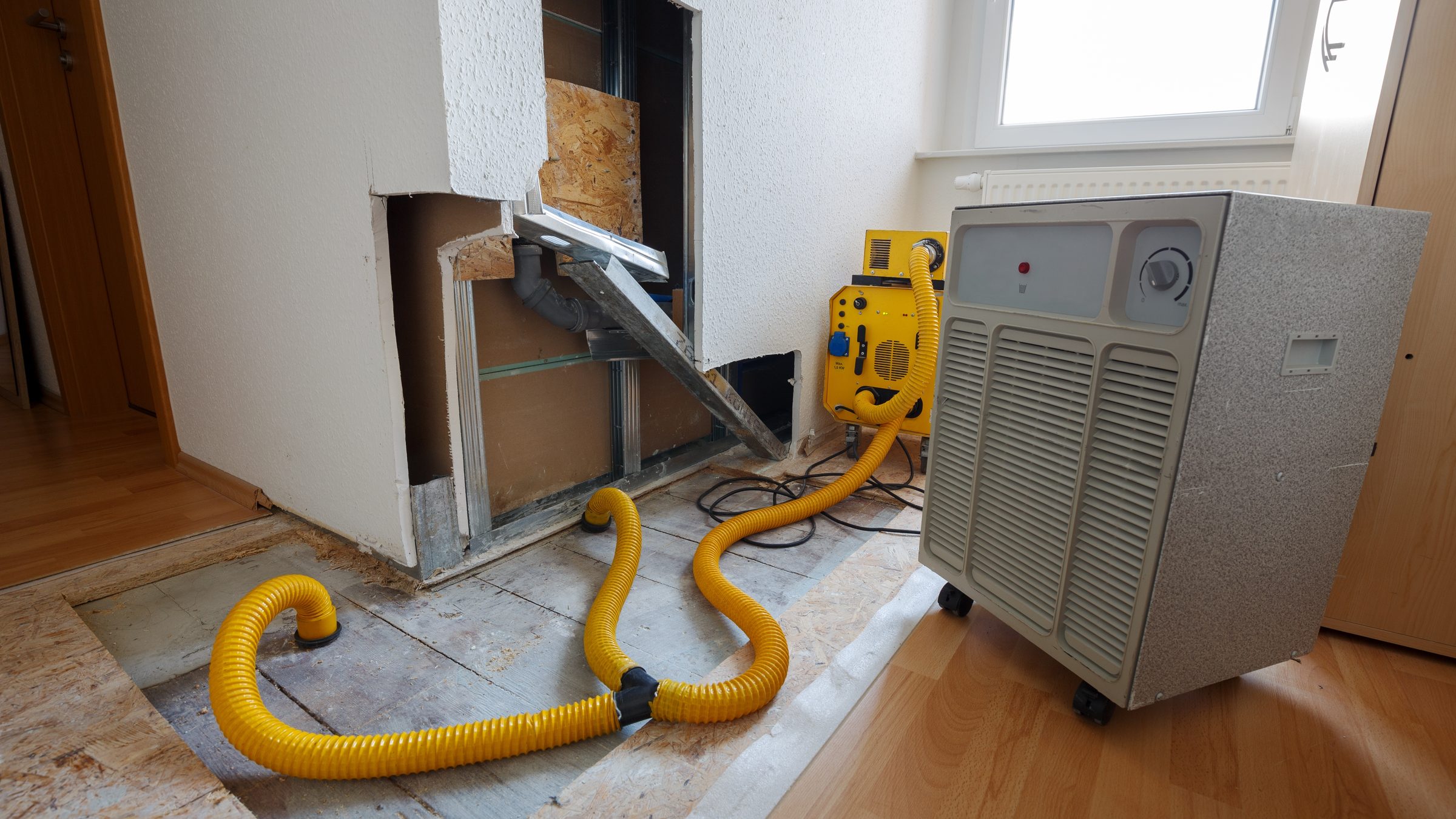
Drying equipment set after a flood cut. Opening the wall is not damage — it is the only way to reach the insulation and the bottom plate before mold growth starts behind a surface that looks fine.
Coverage
Towns and neighborhoods we cover in Staten Island
Rapid response teams on standby across Staten Island, 24 hours a day.
- Annadale
- Arden Heights
- Bulls Head
- Castleton Corners
- Dongan Hills
- Eltingville
- Great Kills
- Grymes Hill
- Huguenot
- Midland Beach
- New Dorp
- New Springville
- Oakwood
- Port Richmond
- Prince’s Bay
- Rosebank
- Silver Lake
- South Beach
- St. George
- Stapleton
- Todt Hill
- Tottenville
- West Brighton
- Westerleigh
Do not see your town? We almost certainly still cover it —ask us.
FAQ
Flood cleanup questions from Staten Island
If yours is not here, call and ask. You will get a straight answer, not a callback from a sales team.
My house is elevated. Why did water still get inside?
Can a backed-up sewer in your basement make you sick?
How is flood water removed from a house?
How long does it take to dry out a house after a flood?
Does homeowners insurance cover flood damage on Staten Island?
What is the difference between remediation and restoration?
Can a house be repaired after a flood?
How much does flood cleanup cost on Staten Island?
Related flood and water damage restoration work
This page is water arriving from outside the building. These cover the water that starts inside it, the weather event that caused it, and what it becomes if it is left.
- Water damage restoration, Staten IslandBurst pipes, failed appliances and supply-line losses — water that started inside.
- Storm & flood damageThe weather event itself, and the make-safe work while it is still going on.
- Sewage backup cleanupCategory three water through a floor drain, and why it is a decontamination job.
- Mold inspection, Staten IslandWhat a flood becomes if it sits, and why New York keeps assessment separate from removal.
- Flooded basement cleanupThe same work across the Narrows, on Nassau and Suffolk housing stock.
- Fire damage restoration, NYCThe other emergency line, and the one where firefighting water becomes its own flood.
- Talk to a personTwo lines, both answered 24 hours a day, including holidays.
Every hour the water sits, the job gets bigger
Tell us how much water, where it came from, and how long it has been there, and we will tell you honestly what this needs. If the answer is that it can wait until morning, we will say that.
Answered by a person, 24/7· Rapid response teams on standby· We handle your insurance