
Brooklyn, New York City
Mold Inspection, Brooklyn
We find the water that caused it, read the party wall before anyone writes a scope, and bring in an independent licensed mold assessor when New York says we have to.
- Clearance
- Third-party
- Phones answered
- 24/7
- Counties & boroughs
- 7
Certified & licensed · Fully insured · Documented to New York State requirements
Our certifications and credentials
IICRC Certified Technicians
Industry standard certification
OSHA Certified
Safety trained crews
25+ Years Experience
Ownership, in restoration
Licensed & Insured
Certificate on request
Local conditions
Why a Brooklyn mold inspection starts next door
Brooklyn is party-wall territory — attached brownstones and row houses — and that changes the job. Water in one brownstone does not stay in one brownstone, so the first thing we do on a row-house loss is meter the neighbors before anyone starts drying. Red Hook, Gowanus, and the Columbia Street waterfront sit at or near the surge line and flooded severely in Sandy. Cellar-level commercial space along the avenues carries the same below-grade exposure as residential, usually with far more inventory sitting directly on the slab.
That is the part that makes Brooklyn different, and it is the part every competitor leaves out. On attached stock the wall you are looking at is shared, the joists frequently run into it, and the roof drainage often is too. So the first thing our inspector does on a row-house job is read the adjoining bay, because a scope written without that reading is a scope you may end up paying for twice. Red Hook, Gowanus and the Columbia Street waterfront add the surge history on top, and cellar-level retail along the avenues carries the same below-grade exposure as a residential cellar, usually with far more inventory sitting directly on the slab.
What we find behind a mold problem here, in order of frequency
- Party-wall and shared-joist migration between attached houses
- Cellar dampness from groundwater and failed area drains
- Parapet, roof-edge and flashing failures on pre-war multifamily
- Long-running plumbing leaks inside a wall cavity or a bathroom stack
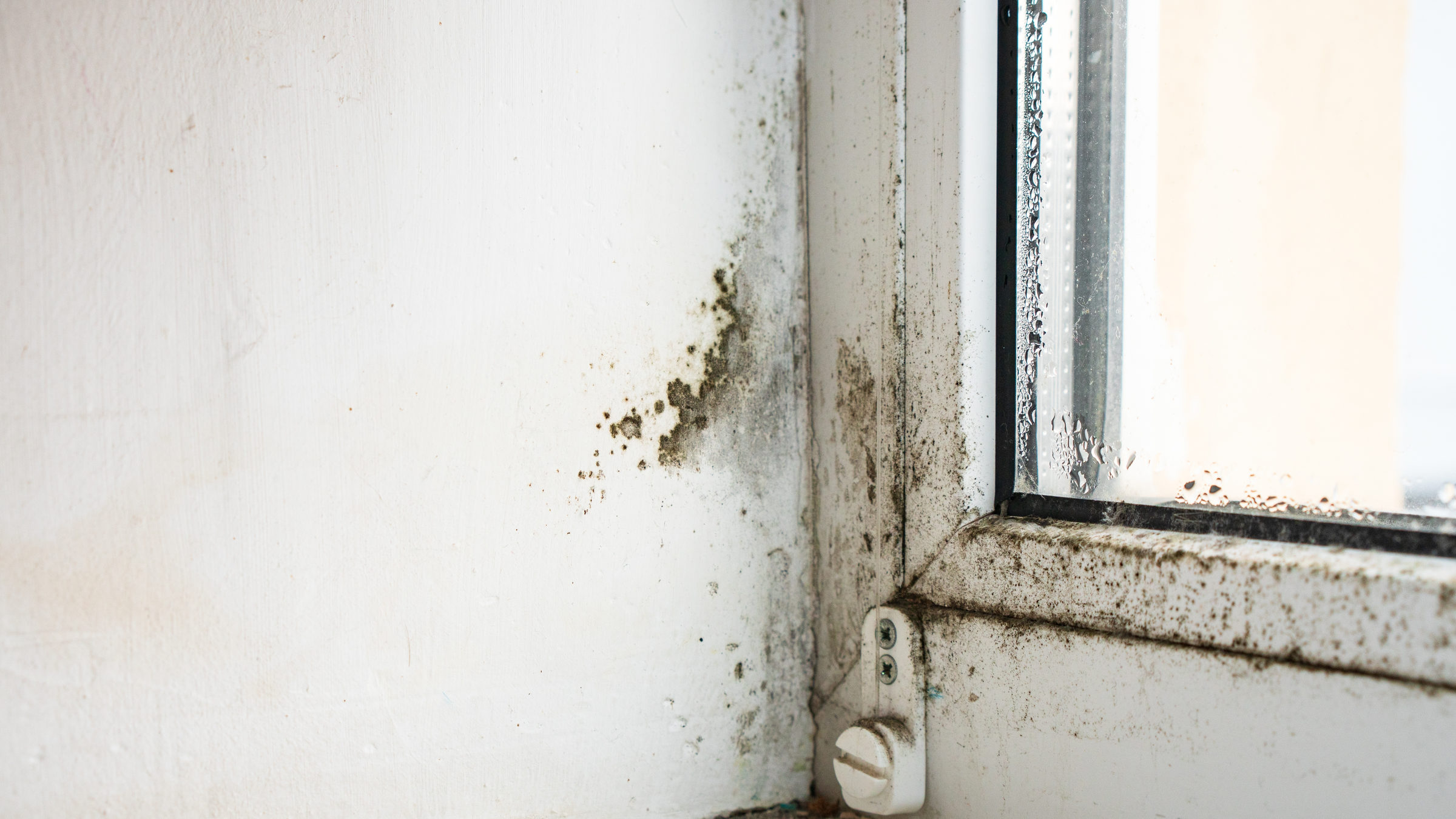
- Condensation on cold exterior walls and window reveals in buildings on steam heat
- Cellar-level retail and storage losses along the avenues
- Gowanus and Red Hook groundwater and surge intrusion
Not every job here is a brownstone. Brooklyn also has modern high rises along the waterfront, and commercial properties with cellar storage under the avenues, and both bring their own mold concerns: in a new tower it is usually a mechanical room or a condensate line, and in a cellar it is groundwater plus stock sitting on the slab. Property managers and small business owners in Brooklyn, NY call for the same reason homeowners do — they need somebody to name the source before the building or the landlord will act. The health risks get argued about; the risk to indoor air quality and to the finishes is easier to establish, and it is what a report can prove.
None of that is fixed by killing the mold. Mold is what moisture leaves behind, so the useful half of an inspection is the half that finds the original source. If water is still arriving, the honest first call iswater damage restorationand structural drying, not testing. Left long enough, wet framing behind that plaster becomes a structural integrity problem rather than a mold problem, and the two get repaired in a very different order.
Row houses
Reading a party wall before anyone writes a scope
Five signals tell you where the water is actually coming from on an attached house. Each one changes the next step, and getting this wrong is the most expensive mistake available on a Brooklyn mold job.
| What you can see | What it usually means | What we do next |
|---|---|---|
| Growth stops dead at a stud line | Water is arriving from one cavity and not the next. | Meter the adjoining bay before opening anything. The source is often above, not beside. |
| It appeared after work next door | A roof, a stack or a cellar was opened on the other side of the masonry in the recent past. | Read both sides on the same day. The comparison is the evidence. |
| Wet at the base of the shared wall only | Groundwater or a failed cellar drain, tracking along the footing. | Check grading, area drains and the cellar floor slab before assuming a plumbing leak. |
| Worst on the top floor, near the parapet | A parapet or roof-edge failure, which on attached stock is frequently shared. | Look at the roof before the wall. Nothing inside gets fixed while that is still open. |
| Only in January, only near windows | Condensation on cold masonry, not a leak at all. Blistered paint along the reveal is the usual first sign. | Ventilation, insulation and interior humidity. Removal without that is a seasonal subscription. |
Black mold gets the headlines and colour is close to useless as a diagnostic. Several species present as black, some of the more allergenic ones are not, and the species almost never changes the removal method. What changes the method is the material: non-porous surfaces clean, porous material comes out. Treat any significant indoor mold growth seriously and fix the moisture, whatever colour it is.
New York law
One question to ask every mold company you call
Ask whether they intend to do both the assessment and the removal. If the answer is yes and the job is any size, they are describing something New York does not permit.
Three licences
Since January 2016, Article 32 of the New York Labor Law has required three separate licences from the State Department of Labor: a licensed mold assessor, who inspects and writes the remediation plan; amold remediation contractor, who performs the removal; and mold abatement workers. Different licences, different requirements.
They cannot be the same firm
The law forbids one company holding both roles on the same project. Whoever is paid to find the problem should not also be paid to remove it, and whoever did the removal should not be the one certifying that it passed. That is why post-remediation clearance testing goes to an independent assessor rather than back to the contractor.
Where the line falls
The rules bite on projects covering more than about ten square feet. A homeowner working on their own residence is exempt in their own house. That exemption does not extend to a contractor you pay, and it does not apply to rental property — which covers a great deal of Brooklyn.
How we work inside that rule.We do the remediation. Formal mold assessment, the written plan and the post-remediation clearance test go to a New York licensed mold assessor who is independent of us — a professional we do not employ and do not pay for a result. We will arrange it, and you are free to appoint your own instead. We would rather you did than wonder about it. We do not clear our own work.
Once the assessment is written, the mold remediation process itself is not mysterious: containment materials and negative air so spores cannot reach the clean half of the house, removal of the porous material that cannot be cleaned, source repair, and clearance. The full sequence sits on ourmold remediation servicespage, and the Brooklyn version of the removal work is on themold removal in Brooklynpage. What changes from job to job is scale, not order.
Our process
How a mold inspection runs on a Brooklyn row house
No step here is optional and none of them can be reordered. If a contractor skips one, ask which.
01
The initial call
What you can see, what it smells like, how long it has been there, and which wall it is on. On a row house, which wall it is on is the question that changes everything that follows.
02
Meter the party wall first
Before anything else we read the shared wall and the joist bay running into it. Water in one brownstone does not stay in one brownstone, and finding that out after the drywall is back on is expensive.
03
Walk the water, not the mold
Visible mold growth is the symptom. We trace it to the roof, the parapet, the cellar wall, the plumbing leak or the condensation that put water there, because remediation without that repair is a redo.
04
Meter and map
Moisture meters on every affected surface and thermal imaging where a wall cavity, a chase or a subfloor is suspect. Water stains lie about their edges. Moisture detection tools do not.
05
Decide whether sampling earns its cost
If you can see it and smell it, air samples mostly confirm what you already know. Testing earns its cost when the source is hidden, when a health issue is involved, or when a sale, a board or a claim needs a documented record.
06
Independent assessment where the law requires it
Formal mold assessment and the written remediation plan go to a New York licensed mold assessor who is not us. That separation is a legal requirement, not a preference.
07
Scope, remediate, clear
You get a written scope for the removal work. Containment, HEPA air filtration and source repair follow, and post-remediation clearance testing goes back to the independent assessor.
Call us
Not sure whether you need mold testing at all?
Call and describe it, including which wall it is on. Mold does not need the same response a burst pipe does, but the water behind it usually does, and we would rather tell you that on the phone than sell you a lab report you did not need.
Answered 24 hours a day, 7 days a week
Cost
What decides the price, and why we will not quote it blind
Every mold removal quote you get in Brooklyn is built from the same five inputs. If a company gives you a figure before knowing all five, they are guessing and one of you pays for the guess later.
The extent of the affected area
Square footage, and whether it crosses the ten-square-foot line that triggers New York licensing rules.
What the material is
Non-porous surfaces clean. Drywall, insulation, carpet and furniture come out. That single distinction moves the number more than anything else.
Containment
Barriers, negative air and HEPA filtration are a fixed setup cost with specialized equipment, regardless of how small the affected area is.
The source repair
A failed gutter is cheap. A parapet, a stack or a cellar drain is not. Skipping it is cheaper still, and it is why the mold comes back.
Assessment and clearance
A separate line paid to a separate licensed company, because it legally cannot be bundled with the removal.
On an attached house there is a sixth input nobody advertises: how much of the work has to happen on the other side of the party wall. That is a conversation with a neighbour rather than a line on an estimate, and it is far easier to have before the containment goes up than after.
One thing worth understanding about how mold remediation companies price this. Professional mold remediation is quoted on the extent of the contamination and the material it is sitting on, so an inspector has to determine both before anybody can put a figure on the entire process. That is why we assess the work area and read the wall rather than quoting from a photograph, and why the answer to “how much to get rid of it” is a walkthrough rather than a price list. If a company can tell you what it costs to remove mold from a wall they have not seen, ask what they are assuming, because they are assuming something.
Containment and HEPA air filtration on a row-house job. The barrier is not theatre — without negative air, removal pushes mold spores into the clean half of the house.
Coverage
Neighborhoods we cover for mold inspection in Brooklyn
Crews local to the borough, so the inspector who reads your party wall works these blocks routinely rather than driving in from another county.
- Bay Ridge
- Bedford-Stuyvesant
- Bensonhurst
- Boerum Hill
- Brooklyn Heights
- Bushwick
- Canarsie
- Carroll Gardens
- Clinton Hill
- Coney Island
- Crown Heights
- Dyker Heights
- Flatbush
- Fort Greene
- Gerritsen Beach
- Gowanus
- Gravesend
- Greenpoint
- Marine Park
- Mill Basin
- Park Slope
- Red Hook
- Sheepshead Bay
- Sunset Park
- Williamsburg
- Windsor Terrace
Do not see your town? We almost certainly still cover it —ask us.
FAQ
Mold inspection questions from Brooklyn homeowners
If yours is not here, call and ask. You will get a straight answer, not a callback from a sales team.
The mold is on the party wall. Is it my problem or my neighbour’s?
Can black mold really be remediated, or does the drywall always come out?
Can a house full of mold be saved?
How is a mold test actually done?
Who pays for a mold inspection in a co-op or a rental?
Does mold in the cellar affect the floors above?
Related restoration work in Brooklyn
Inspection tells you what you have. These are the related services that follow from it, and the water problems that cause it in the first place. To schedule one, contact us with the location and what you can see. Sibling pages coverStaten IslandandLong Island, where the housing stock and the causes are different again.
- Mold removal in BrooklynThe remediation itself: containment, removal, source repair and independent clearance.
- Water damage restorationExtraction and structural drying before a wet row house becomes a mold problem.
- Storm and flood damageGowanus and Red Hook surge, groundwater intrusion, and the category-three water that follows.
- Cellar and basement moldThe below-grade version of this problem, in the format the question is usually asked.
- Mold inspection across NYCCost structure, Local Law 55 and what a report has to contain.
- Talk to a personTwo lines, answered 24 hours a day, including holidays.
Get a straight answer about the mold in your house
Describe what you can see and smell, which wall it is on, and how long it has been there. We will tell you whether this needs an inspection, a plumber, or a conversation with your neighbour, before anyone quotes you for removal.
Answered by a person, 24/7