
Commack · Suffolk County · 24/7
Water damage restoration, Commack, NY
Rain-flooded basements, cesspool backups and supply-line failures in 1950s and 1960s houses, on both sides of the Huntington–Smithtown line. Dried to a meter reading and documented for the claim.
- Phones answered
- 24/7
- Where
- Smithtown & Huntington
IICRC certified technicians · Licensed & insured · Moisture logs for your claim
Our certifications and credentials
IICRC Certified Technicians
Industry standard certification
OSHA Certified
Safety trained crews
25+ Years Experience
Ownership, in restoration
Licensed & Insured
Certificate on request
Local conditions
What actually goes wrong in Commack
Commack is one hamlet in two towns. Roughly two-thirds of it is in the Town of Smithtown and a third in the Town of Huntington, its homes use several mailing ZIP codes, and its school district does not follow its borders. It is also inland in a way Smithtown is not: no shoreline, no mapped stream, no FEMA high-risk flood zone, and a water table dozens of feet down in sand and gravel. The houses went up fast, seven in ten of them between 1950 and 1969, and apart from two small county sewer districts, Commack is on cesspools and septic.
Specific to Commack
- About two-thirds of Commack lies in the Town of Smithtown and one-third in the Town of Huntington, and between Hauppauge Road and Jericho Turnpike the town line leaves Commack Road and cuts through side streets like Genesee Drive, so which building department issues a repair permit depends on the house.
- USGS wells in Commack put the water table roughly 40 to 100 feet down and FEMA maps no high-risk flood zone anywhere in the hamlet, so the basements that flooded here in August 2024 took rain, not groundwater, the opposite of the water table that rises into basements along Smithtown’s Northeast Branch.
- Rain getting into basements in cloudbursts, as on August 18–19, 2024
- Cesspool and septic backup when the system cannot take any more
- Supply-line, water-heater and appliance failures in 1950s and 1960s houses
- Permits and inspections from two different towns, depending on the street
A hamlet built in twenty years
Commack was farmland into the 1950s. The Northern State Parkway reached it in 1952 and the Sunken Meadow Parkway in 1954, and the building that followed was fast: 72 percent of Commack’s homes were built between 1950 and 1969, 44 percent in the 1960s alone, according to the Census Bureau’s 2020–24 estimates. Ninety-three percent are single-family detached houses and nearly as many are owner-occupied.
Houses of that age fail in predictable places: supply lines and fittings that have been in the walls for sixty years, a frozen water line on an outside wall in a cold snap, water heaters on their third or fourth replacement, and basements finished long after the house was built. FEMA’s flood-insurance record for the 11725 ZIP code is small, but of the claims that note a foundation, 19 of 20 had a basement and 17 of those were finished.
Inland, on sand and gravel
Commack has no shoreline and no mapped stream, and FEMA puts none of it in a high-risk flood zone. It sits on outwash sand and gravel, and the U.S. Geological Survey’s wells inside the hamlet put the water table roughly 40 to 100 feet below the surface, shallowest in the northeast.
That makes Commack the opposite of Smithtown’s Northeast Branch, where the water table comes up into basements. When a Commack basement floods, the water came from above, through a window well, a door or a crack after a cloudburst, or from inside the house, from a pipe, a water heater or the cesspool. Each of those is a different claim, and the first job is working out which one it was.
Cesspools on both sides of the line
Apart from two small county sewer districts, one covering industrial and office parcels and one a cluster of townhouses, Commack is on cesspools and septic, whichever town the house is in. Suffolk County’s hazard plan explains why: in Suffolk only the Atlantic-coast parts of Babylon, Islip and Brookhaven have sanitary sewers.
A cesspool backs up when it can no longer take what the house sends it, whether it is full, clogged or overwhelmed by storm water, and the backup comes through the lowest drain in the house. That is category three water. Stop running water, keep people and pets out of the basement, and have a cesspool contractor pump the system; the sewage cleanup, decontamination and drying are our part.
Flood damage on record in Commack
August 18–19, 2024
The National Weather Service recorded water rescues of stranded motorists on Fisher Road late on the 18th and, overnight, multiple homes with basement flooding in Commack, Smithtown and St. James. One Commack weather station logged 8.82 inches. FEMA’s three flood-insurance claims from the 11725 ZIP that week were all rainfall, in a low-risk zone.
1979
The busiest year in Commack’s flood-insurance record: 10 of the ZIP code’s 38 claims since 1978 came in 1979, a year of unusually heavy precipitation on Long Island according to Suffolk’s hazard plan.
What the job is
Water damage restoration services in Commack
Commack water damage restoration runs in two halves, and the order matters more than the equipment.
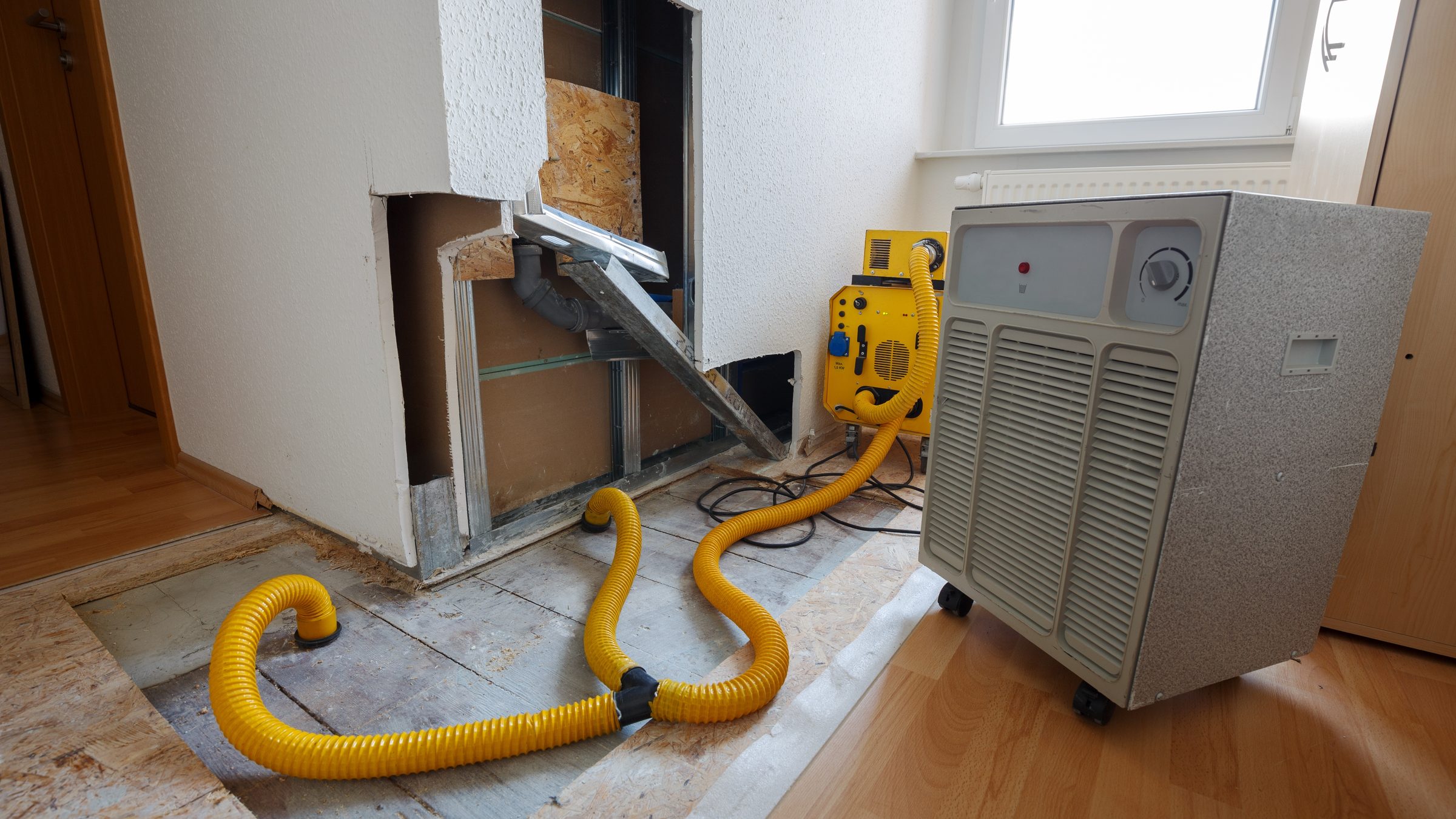
Water mitigation comes first: stop the source, remove standing water, extract what a pump cannot lift and clean up whatever the water contaminated. Then structural drying, with air movers and dehumidifiers running until moisture meters show the framing, subfloor and drywall back at their dry standard. Rush the drying process and the hidden moisture left behind keeps doing further damage out of sight, which is where mold growth starts. The EPA’s guidance is to dry wet materials within 24 to 48 hours to prevent it, which is why the first day decides so much of the job.
Restoration is the second half: the structural repairs and finishes that restore the property to its pre-loss condition. None of it should start until the drying equipment is out and the moisture levels are logged. Ask any restoration company for that log before a water damage repair closes the walls, because it is the only proof the structure was dry, and it is what your insurance company will ask to see. The sequence is the same for every water damage cleanup, whether the source was a burst pipe, a flooded basement or a sewage backup. What changes is the water category. The industry sorts water into clean, gray and black, categories one to three, and sewage and floodwater are black water that carries bacteria and viruses, so porous materials they touched come out rather than get dried.
Until someone arrives, shut the water off at the main if the source is inside, stay off wet floors where the power may still be live, and do not run a household vacuum on standing water.
Our process
The water and flood damage restoration process in Commack
No step here is optional and none of them can be reordered. If a contractor skips one, ask which.
01
Emergency contact
A person answers, day or night. We confirm your address, the water source, and whether the power is safe.
02
Inspection and moisture mapping
We meter every affected surface and map how far the water actually traveled, which is almost always further than it looks.
03
Water extraction
Truck-mounted and portable extraction pulls standing water before it wicks further into the structure.
04
Drying and dehumidification
Air movers and dehumidifiers run to a target moisture content, monitored daily against the dry standard.
05
Cleaning and sanitizing
Affected contents and surfaces are cleaned, deodorized, and treated to stop secondary growth.
06
Restoration
Drywall, flooring, and finishes go back, and you get the full moisture log for your claim.
The clock started when the water did
What happens if you wait
Restoration is priced by how far the damage got, and damage is a function of time. This is the progression we see on almost every untreated water loss.
Minutes
Water finds every porous thing you own
It wicks up drywall, under flooring, and into subfloor and insulation. What you can see on the floor is a fraction of what is already wet.
1-24 hrs
Drywall swells, finishes bleed, odor starts
Furniture legs stain carpet. Laminate delaminates. Paper-faced drywall loses structural integrity and the first musty smell appears.
48-72 hrs
Mold begins to colonize
This is the line that changes the job. Past roughly 48 hours a drying job becomes a remediation job, and the cost and disruption both step up.
1 week +
Structural damage and health risk
Wood warps and swells, fasteners corrode, and spore counts climb. Restoration times and costs rise sharply, and some contents stop being salvageable.
Timelines describe typical residential water losses under normal indoor conditions. Category, temperature, humidity, and materials all shift them. An on-site inspection is the only way to know where your property sits.
Call us
Water damage emergency in Commack?
If it is a water emergency, call the Long Island line. A person picks up at any hour, asks where the water is coming from, and tells you straight whether it needs emergency water removal tonight or can wait for a daylight inspection.
Answered 24 hours a day, 7 days a week
Mold · by appointment
Mold removal in Commack
Commack mold usually follows a one-time event that was never properly dried: a basement that took rain in a cloudburst, a water heater that let go, a backup that was mopped rather than cleaned. The water table is too deep to keep a basement damp the way it can in parts of Smithtown, so persistent growth here points to a specific source, and that source is worth finding before anyone removes anything.
Finished basements are the usual place. If one smells musty on a humid day, have it metered before anyone opens a wall, because the reading tells you how much has to come out.
Mold remediation is booked, not dispatched
Mold remediation is scheduled work. Nobody needs a crew at two in the morning for mold growth that took weeks to appear, and a contractor who sells it as an emergency is selling the fear rather than the fix. The job starts with a survey: where the hidden moisture is coming from, how far the growth goes behind the finish, and whether the area is large enough to fall under New York’s mold rules. Mold prevention after a water loss is mostly moisture control: dry the structure to its standard, then keep indoor humidity between 40 and 60 percent.
Once a project covers more than about ten square feet, Article 32 of the New York Labor Law separates the person who assesses the mold from the company that removes it, and the same firm may not do both on one job. That is why the clearance test at the end goes to an independent assessor, not to us. How mold inspection works on Long Island sets out the whole rule.
How mold damage is removed
Find the moisture source
Growth is the symptom. Remediation without fixing the water is a repeat visit.
Contain the area
Plastic barriers and negative air pressure keep mold spores out of the rooms that are clean.
Filter and remove
HEPA air filtration runs throughout. Porous material that cannot be cleaned comes out; hard surfaces are HEPA vacuumed and given an antimicrobial treatment.
Independent clearance
An assessor who did not do the work tests the space before anything is closed up.
Fire and smoke
Fire damage restoration in Commack
Commack is a gas-heat hamlet: about three households in four heat with gas and one in five with oil, according to the Census Bureau’s 2020–24 estimates, against about half on oil in Smithtown next door. The oil-burner puff back that is a routine smoke job in Smithtown is the exception here.
Here, as in most places, house fires most often start in the kitchen, and the smoke from one does not stay there. In a house with a finished basement and an open stair, it is common to find soot two floors from where the fire was.
Two things hold on every fire job regardless of the house. The water the fire department used is a water loss in its own right and gets extracted and dried before any soot work starts. And soot is acidic: it keeps etching metal, glass and finishes for as long as it sits, which is why smoke damage cleanup is worth starting the day the property is released back to you. Odor elimination comes last, once the soot is off every surface, because deodorizing over soot does not last.
Claims
Will insurance cover water damage in Commack?
Commack’s flood-insurance record is thin: 38 claims from the 11725 ZIP code since 1978, according to FEMA, and the three from August 2024 were rainfall in a low-risk zone. Most Commack water claims are homeowners claims for sudden failures inside the house, plus the water backup endorsement, if the policy has one, when the cesspool or a drain backs up.
If the repair needs a permit, it comes from whichever town the house is in: the Town of Huntington’s building division on the western third of the hamlet, the Town of Smithtown’s building department on the rest. The permit follows the tax parcel, not the mailing address, so check the tax bill if you are not sure.
What a homeowners insurance claim usually covers
The general rule holds everywhere on the island. Sudden and accidental water from inside the house — a burst pipe or supply line, a failed water heater, a split washing-machine hose — is usually covered. Surface water coming in from outside is excluded from standard homeowners policies and is what flood insurance is for. Groundwater seeping through a foundation is a hard claim under either policy, sewer and drain backup is usually a separate endorsement with its own limit, and damage put down to long-term leaks is rarely covered at all.
What your insurance company will want to see
Report the loss to your insurer promptly. Most policies require prompt notice, and a late report is one more thing to argue about. We document damage the way adjusters ask for it: dated moisture readings, photographs of the property damage in every affected area before anything moves, and a line-item scope your insurance carrier can price. That is the insurance paperwork an adjuster actually reads. The claims process stays yours — we are a restoration contractor, not a public adjuster. What is covered, what is not, and how to file goes through it in full.
Serving Commack
Around Commack, NY
Crews work across all of Commack on both sides of the town line, and the hamlets around it: Dix Hills, East Northport, Kings Park, Smithtown and Hauppauge.
Residential and commercial losses come in on the same line, so a home or business in Commack makes the same call. Commercial restoration in Suffolk County covers what changes when it is a business.
- Commack Road
- Jericho Turnpike
- Veterans Memorial Highway
- Townline Road
- Larkfield Road
- Indian Head Road
- Vanderbilt Motor Parkway
- New Highway
- Hoyt Farm
- Dix Hills
- East Northport
- Kings Park
- Hauppauge
- Smithtown
Other Long Island towns
- SmithtownNissequogue groundwater, cesspool backups and the August 2024 storm.
- HicksvilleLevitt slab leaks, sewer backups and inland 1950s houses.
- MassapequaCanal homes, storm drains that back up at high tide, and the Sandy record.
- BabylonBay flooding south of Montauk Highway, tidal drains and the county sewer.
FAQ
Questions Commack homeowners ask
If yours is not here, call and ask. You will get a straight answer, not a callback from a sales team.
Is my Commack house in Huntington or Smithtown?
Is water damage restoration worth it, or should I just replace things?
Why did my basement flood in August 2024 if Commack has a deep water table?
Is a sewage backup in Commack a cesspool problem?
Do you cover Dix Hills, East Northport and Kings Park too?
Water damage in Commack? Call before you start moving things
Where things were sitting when the water arrived is part of the insurance record. Call, tell us where the water came from and how long it has been there, and we will tell you honestly what it needs.
Answered by a person, 24/7· Rapid response teams on standby· We handle your insurance