
Massapequa · Nassau County · 24/7
Water damage restoration, Massapequa, NY
Bay water over the bulkhead, storm drains that run backwards at high tide, and basements that took Sandy. Canal-front and inland Massapequa, extracted, decontaminated and dried to a meter reading.
- Phones answered
- 24/7
- Where
- Oyster Bay’s South Shore
IICRC certified technicians · Licensed & insured · Moisture logs for your claim
Our certifications and credentials
IICRC Certified Technicians
Industry standard certification
OSHA Certified
Safety trained crews
25+ Years Experience
Ownership, in restoration
Licensed & Insured
Certificate on request
Local conditions
What actually goes wrong in Massapequa
Massapequa floods from the bay side. Its shore faces South Oyster Bay, which the Village of Massapequa Park calls the Great South Bay, and south of Merrick Road the streets run down to canals and bulkheads in neighborhoods like Nassau Shores, Harbor Green and Biltmore Shores. When Sandy’s surge came in on October 29, 2012, most of southern Nassau below Merrick Road went under and the creek-side streets flooded as far north as Sunrise Highway. It does not take a hurricane: a nor’easter in January 2017 put one to two feet of water in Nassau Shores.
Specific to Massapequa
- Hurricane Sandy produced 2,711 flood-insurance claims in Massapequa’s 11758 ZIP code, 2,015 of them coded as tidal overflow, while Hicksville’s 11801 has 27 claims in FEMA’s entire record.
- The Town of Oyster Bay has spent upwards of $12 million in federal grant money enlarging drains, adding underground storage, fitting tidal check valves and raising roads on low-lying Massapequa streets like Brockmeyer Drive, Harbor Place and Unqua Circle, because here the bay comes back up through the storm drains.
- Tidal and storm-surge flooding of canal-front homes south of Merrick Road
- Bay water backing up through the storm drains at high tide
- Category three water in anything that crossed the ground or a bulkhead
- Flooded basements, crawlspaces and the enclosures under raised houses
Canal houses, 1950s blocks and flooded basements
Half of Massapequa’s houses were built in the 1950s and 97 percent are detached, according to the Census Bureau’s 2020–24 estimates. Post-war demand replaced the old estates with developments like Harbor Green, Biltmore Estates and Nassau Shores. Harbour Green’s first 113 houses went up between 1932 and 1941, two stories with basements, and after the war the land toward Dartmouth Road was filled and the Gloucester Canal dug out.
The Sandy flood-insurance claims show what that housing looks like from underneath. Of the 2,711 claims in the 11758 ZIP, 968 recorded a basement or enclosure, finished or not, and 370 a below-grade crawlspace. Houses lifted since then have a new space to look after: the enclosure under the raised floor, which is built to let floodwater in and out and has to be finished with that in mind.
South Oyster Bay, storm surge and the canals
Massapequa Creek runs south through the Massapequa Preserve, 423 acres of former New York City watershed land that begins at Merrick Road, past Massapequa Lake and the reservoir and out into the bay through Massapequa Cove. The ordinary tidal range in South Oyster Bay is only about a foot and a half; it is wind-driven tidal surges on top of it that bring the bay into the streets.
Groundwater is not the story here the way it is in Smithtown. Sewering drew the water table down across most of Nassau, as Suffolk County’s own hazard plan notes of the island’s built-up areas. The water intrusion that damages Massapequa houses arrives over the bulkhead, up through the storm drains or out of the sky.
Storm drains that run backwards
About 85 percent of Nassau is on public sewer, with the remaining cesspools concentrated on the North Shore, and the Massapequa Water District’s own history records Nassau County laying sewers through its growth years. The drainage problem here is the other set of pipes.
South Shore storm drains empty into the canals and the bay, so when the tide is high enough the bay comes back up through them and a street floods with no rain at all. After Sandy the Town of Oyster Bay spent upwards of $12 million of federal grant money on the low-lying streets of the Massapequas, among them Harbor Place, Brockmeyer Drive, Clearwater Avenue and Iroquois Place to Unqua Circle: bigger drainage pipe at a better pitch, underground retention, tidal check valves and, in places, a higher road. The work was finished in January 2024.
Water that came in from the street or over the bulkhead is category three, whatever it looks like. Porous materials it reached come out and everything left is decontaminated before drying. Bay water also leaves salt behind in the framing, which keeps pulling moisture back in until it is washed out.
Flood damage on record in Massapequa
October 29, 2012 (Sandy)
A surge of about eight to nine feet on a normal high tide put three to five feet of water into southern Nassau. The National Weather Service recorded most of it below Merrick Road as completely inundated, creek-side streets flooded up to Sunrise Highway, and major residential damage in Massapequa. FEMA’s records hold 2,711 flood-insurance claims from Sandy in the 11758 ZIP code alone.
August 28, 2011 (Irene)
The storm before Sandy: 691 flood-insurance claims from the 11758 ZIP code.
January 24, 2017
A nor’easter, not a hurricane, put one to two feet of water on Delta Road and in Nassau Shores, according to the National Weather Service.
January 25, 2024
The Town of Oyster Bay finished its drainage and tidal check-valve project on the low-lying streets of the Massapequas.
What the job is
Water damage restoration services in Massapequa
Massapequa water damage restoration runs in two halves, and the order matters more than the equipment.
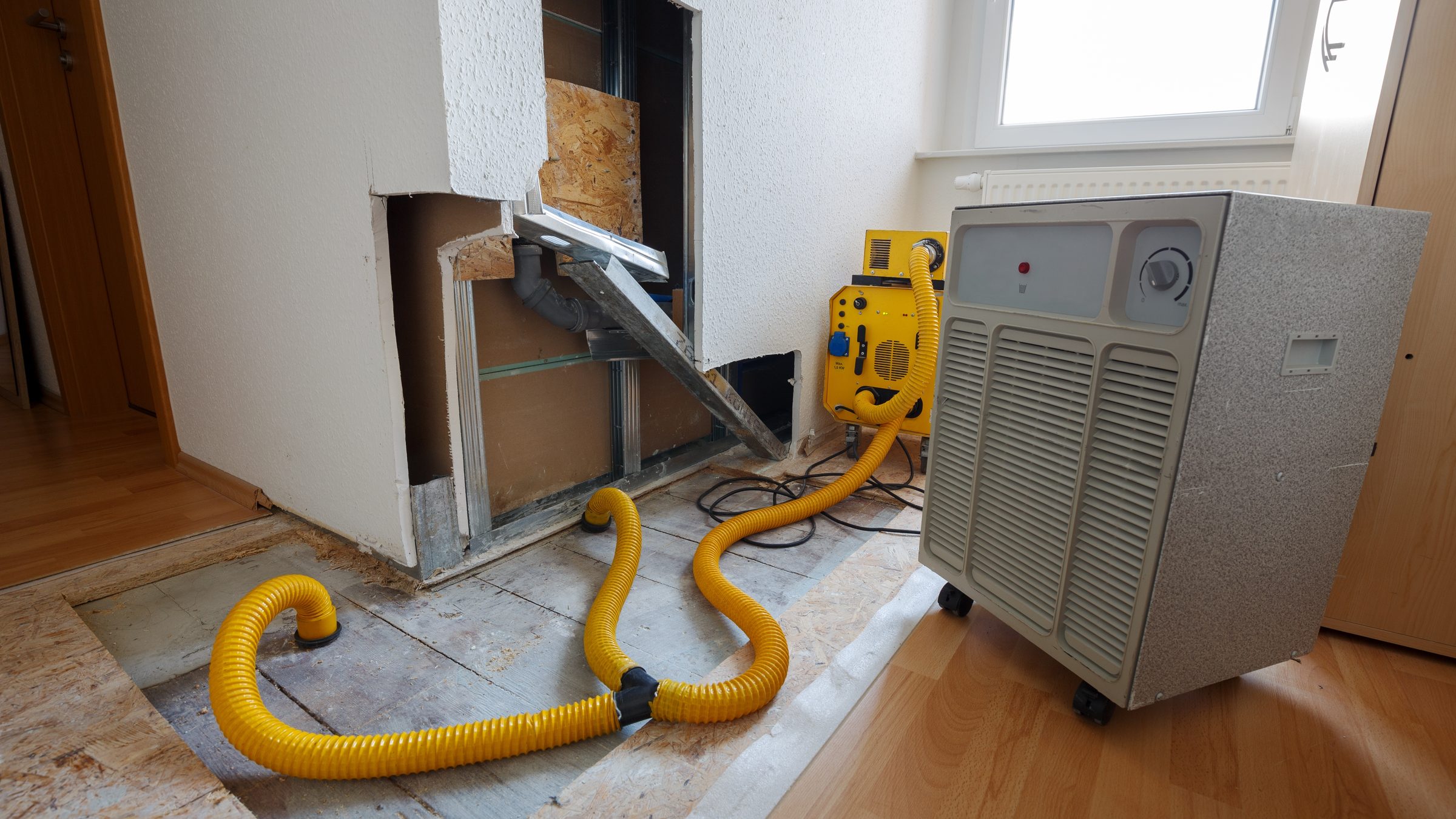
Water mitigation comes first: stop the source, remove standing water, extract what a pump cannot lift and clean up whatever the water contaminated. Then structural drying, with air movers and dehumidifiers running until moisture meters show the framing, subfloor and drywall back at their dry standard. Rush the drying process and the hidden moisture left behind keeps doing further damage out of sight, which is where mold growth starts. The EPA’s guidance is to dry wet materials within 24 to 48 hours to prevent it, which is why the first day decides so much of the job.
Restoration is the second half: the structural repairs and finishes that restore the property to its pre-loss condition. None of it should start until the drying equipment is out and the moisture levels are logged. Ask any restoration company for that log before a water damage repair closes the walls, because it is the only proof the structure was dry, and it is what your insurance company will ask to see. The sequence is the same for every water damage cleanup, whether the source was a burst pipe, a flooded basement or a sewage backup. What changes is the water category. The industry sorts water into clean, gray and black, categories one to three, and sewage and floodwater are black water that carries bacteria and viruses, so porous materials they touched come out rather than get dried.
Until someone arrives, shut the water off at the main if the source is inside, stay off wet floors where the power may still be live, and do not run a household vacuum on standing water.
Our process
The water and flood damage restoration process in Massapequa
No step here is optional and none of them can be reordered. If a contractor skips one, ask which.
01
Emergency contact
A person answers, day or night. We confirm your address, the water source, and whether the power is safe.
02
Inspection and moisture mapping
We meter every affected surface and map how far the water actually traveled, which is almost always further than it looks.
03
Water extraction
Truck-mounted and portable extraction pulls standing water before it wicks further into the structure.
04
Drying and dehumidification
Air movers and dehumidifiers run to a target moisture content, monitored daily against the dry standard.
05
Cleaning and sanitizing
Affected contents and surfaces are cleaned, deodorized, and treated to stop secondary growth.
06
Restoration
Drywall, flooring, and finishes go back, and you get the full moisture log for your claim.
The clock started when the water did
What happens if you wait
Restoration is priced by how far the damage got, and damage is a function of time. This is the progression we see on almost every untreated water loss.
Minutes
Water finds every porous thing you own
It wicks up drywall, under flooring, and into subfloor and insulation. What you can see on the floor is a fraction of what is already wet.
1-24 hrs
Drywall swells, finishes bleed, odor starts
Furniture legs stain carpet. Laminate delaminates. Paper-faced drywall loses structural integrity and the first musty smell appears.
48-72 hrs
Mold begins to colonize
This is the line that changes the job. Past roughly 48 hours a drying job becomes a remediation job, and the cost and disruption both step up.
1 week +
Structural damage and health risk
Wood warps and swells, fasteners corrode, and spore counts climb. Restoration times and costs rise sharply, and some contents stop being salvageable.
Timelines describe typical residential water losses under normal indoor conditions. Category, temperature, humidity, and materials all shift them. An on-site inspection is the only way to know where your property sits.
Call us
Water damage emergency in Massapequa?
If it is a water emergency, call the Long Island line. A person picks up at any hour, asks where the water is coming from, and tells you straight whether it needs emergency water removal tonight or can wait for a daylight inspection.
Answered 24 hours a day, 7 days a week
Mold · by appointment
Mold removal in Massapequa
After a tidal flood, mold is a question of what was left in the walls. Houses that were gutted and rebuilt after Sandy are generally sound. The trouble is the ones where wet insulation, a bottom plate or a subfloor was dried in place without being cleaned, and the growth comes back every humid summer.
In a raised house, check the enclosure underneath and anything stored in it. It is built to let floodwater in and out, and whatever sat in it through a tide should be treated as having been in category three water.
Mold remediation is booked, not dispatched
Mold remediation is scheduled work. Nobody needs a crew at two in the morning for mold growth that took weeks to appear, and a contractor who sells it as an emergency is selling the fear rather than the fix. The job starts with a survey: where the hidden moisture is coming from, how far the growth goes behind the finish, and whether the area is large enough to fall under New York’s mold rules. Mold prevention after a water loss is mostly moisture control: dry the structure to its standard, then keep indoor humidity between 40 and 60 percent.
Once a project covers more than about ten square feet, Article 32 of the New York Labor Law separates the person who assesses the mold from the company that removes it, and the same firm may not do both on one job. That is why the clearance test at the end goes to an independent assessor, not to us. How mold inspection works on Long Island sets out the whole rule.
How mold damage is removed
Find the moisture source
Growth is the symptom. Remediation without fixing the water is a repeat visit.
Contain the area
Plastic barriers and negative air pressure keep mold spores out of the rooms that are clean.
Filter and remove
HEPA air filtration runs throughout. Porous material that cannot be cleaned comes out; hard surfaces are HEPA vacuumed and given an antimicrobial treatment.
Independent clearance
An assessor who did not do the work tests the space before anything is closed up.
Fire and smoke
Fire damage restoration in Massapequa
About a third of Massapequa homes heat with oil, according to the Census Bureau’s 2020–24 estimates, so puff back is a real job here just as it is inland. The South Shore adds one rule: a boiler, burner or water heater that sat in floodwater needs a heating technician to look at it before it is fired again.
Two things hold on every fire job regardless of the house. The water the fire department used is a water loss in its own right and gets extracted and dried before any soot work starts. And soot is acidic: it keeps etching metal, glass and finishes for as long as it sits, which is why smoke damage cleanup is worth starting the day the property is released back to you. Odor elimination comes last, once the soot is off every surface, because deodorizing over soot does not last.
Claims
Will insurance cover water damage in Massapequa?
Massapequa is flood-insurance country. Water that came in over the bulkhead, through the storm drains or up from the street is flood damage, which standard homeowners policies exclude; it is paid, if at all, by an NFIP or private flood policy. Wind-driven rain through a roof the same storm opened is usually a homeowners claim, so both policies can be in play on one house.
Flood policies are strict about what they cover below the lowest floor, so photograph the basement or enclosure and everything in it before anything goes to the curb. Those photographs, with dated moisture readings, are what the adjuster works from.
What a homeowners insurance claim usually covers
The general rule holds everywhere on the island. Sudden and accidental water from inside the house — a burst pipe or supply line, a failed water heater, a split washing-machine hose — is usually covered. Surface water coming in from outside is excluded from standard homeowners policies and is what flood insurance is for. Groundwater seeping through a foundation is a hard claim under either policy, sewer and drain backup is usually a separate endorsement with its own limit, and damage put down to long-term leaks is rarely covered at all.
What your insurance company will want to see
Report the loss to your insurer promptly. Most policies require prompt notice, and a late report is one more thing to argue about. We document damage the way adjusters ask for it: dated moisture readings, photographs of the property damage in every affected area before anything moves, and a line-item scope your insurance carrier can price. That is the insurance paperwork an adjuster actually reads. The claims process stays yours — we are a restoration contractor, not a public adjuster. What is covered, what is not, and how to file goes through it in full.
Serving Massapequa
Around Massapequa, NY
Crews work across the Massapequas, from Massapequa and Massapequa Park to North and East Massapequa, and along the South Shore canals to Seaford and the Suffolk line.
Residential and commercial losses come in on the same line, so a home or business in Massapequa makes the same call. Commercial restoration in Nassau County covers what changes when it is a business.
- Nassau Shores
- Harbor Green
- Biltmore Shores
- Bar Harbour
- Unqua Point
- Massapequa Park
- North Massapequa
- East Massapequa
- Merrick Road
- Sunrise Highway
- Broadway
- Hicksville Road
- Massapequa Preserve
- Seaford
Other Long Island towns
FAQ
Questions Massapequa homeowners ask
If yours is not here, call and ask. You will get a straight answer, not a callback from a sales team.
Why does my Massapequa street flood when it is not raining?
How can you tell if water damage is permanent?
Is floodwater from the canal always category three?
My house was raised after Sandy. What floods now?
Do you work in Massapequa Park and Seaford too?
Water damage in Massapequa? Call before you start moving things
Where things were sitting when the water arrived is part of the insurance record. Call, tell us where the water came from and how long it has been there, and we will tell you honestly what it needs.
Answered by a person, 24/7· Rapid response teams on standby· We handle your insurance