
Hicksville · Nassau County · 24/7
Water damage restoration, Hicksville, NY
Slab leaks in the Levitt houses, supply-line and water-heater failures in the 1950s blocks, and sewer backups on Nassau County’s line. Found with a meter, dried to a reading and documented for the claim.
- Phones answered
- 24/7
- Where
- Town of Oyster Bay
IICRC certified technicians · Licensed & insured · Moisture logs for your claim
Our certifications and credentials
IICRC Certified Technicians
Industry standard certification
OSHA Certified
Safety trained crews
25+ Years Experience
Ownership, in restoration
Licensed & Insured
Certificate on request
Local conditions
What actually goes wrong in Hicksville
Hicksville is inland Nassau: about 150 feet above sea level, no shoreline, and storm water that drains into fenced recharge basins rather than to a creek or the bay. So the water that damages houses here almost always comes from inside them, from a supply line, a water heater, a washing-machine hose or a sewer lateral. More than half the houses were built in the 1950s and nearly all of them are detached, and on the Levittown side a share of them sit on the original Levitt slab, with the heating pipes inside the floor.
Specific to Hicksville
- The Levittown side of Hicksville is part of the original Levitt development, where houses were built on concrete slabs with copper radiant-heat tubing cast into the floor; the Census Bureau puts 15 percent of Hicksville’s homes in the 1940s, the Levitt years, against 2 percent in Plainview next door.
- At about 150 feet above sea level and with no shoreline, the Hicksville ZIP code has 27 flood-insurance claims in FEMA’s entire record, while Massapequa’s filed 2,711 from Hurricane Sandy alone.
- Slab leaks in original Levitt radiant tubing that drain into the ground unseen
- Supply-line, water-heater and washing-machine failures inside the house
- Sewer lateral and main backups on the county system
- Cloudburst water getting in at grade when the storm drains fall behind
Levitt slabs and 1950s houses
The Levitt development that built Levittown did not stop at its postal zone. Levittown’s own history counts part of Hicksville’s 11801 inside it, and locals call it the Levittown section of Hicksville. The Census Bureau’s 2020–24 estimates put 15 percent of Hicksville’s homes in the 1940s and 58 percent in the 1950s; next door in Plainview the 1940s figure is 2 percent.
Levitt’s houses were built on concrete slabs, which took a change to the building code, and heated by hot water running through copper tubing cast into the slab, with no insulation or vapor barrier beneath it. When the copper began to fail, the leaks drained down into the ground instead of coming up through the floor, so small ones went unnoticed until they were not small, and by 1965 owners were being advised to disconnect the floor coils and fit baseboard convectors. Some Hicksville Levitts were converted decades ago and some were not, and it is the first thing we ask.
A slab leak is a different job from a basement flood. There is usually no standing water to pump out: the moisture is in the slab and under the flooring, and the drying plan is built around readings taken through the floor covering rather than around extraction.
No shoreline, and a water table far below
Hicksville has no shoreline, and its storm drains run to recharge basins. The U.S. Geological Survey counted about 80 of them in the Bethpage–Hicksville–Levittown area, where runoff soaks back down to the aquifer the water district pumps from. The Town of Oyster Bay calls them sumps; its drainage division looks after the Town-owned ones, and each has its number on a sign at the gate, which is the number to give when you report one backing up.
The water table sits dozens of feet below the basement floor, so the groundwater seepage behind so many Smithtown claims is not a Hicksville problem. When a Hicksville basement or slab takes water, it came from a pipe, an appliance, the sewer or rain getting in at the surface, and each of those is a different claim.
On the county sewer since 1980
Hicksville has been on Nassau County’s sanitary sewer since about 1980, according to the U.S. Geological Survey; before that, every house had a cesspool or septic tank. About 85 percent of Nassau is sewered against 26 percent of Suffolk, so a Hicksville backup is a different animal from one in Smithtown.
Here a sewage backup is a blocked lateral, the pipe from the house to the street, or a main surcharged in a heavy storm, not a saturated leaching field. Both put category three water on the floor. Stop using the fixtures, stay out of the water, and do not let anyone tell you a wet-vac and bleach is the cleanup: porous materials the water reached come out, and what stays is cleaned and decontaminated before it is dried.
Flood damage on record in Hicksville
August 18–19, 2024
The storm that put eight to ten inches on Suffolk’s North Shore dropped 2.61 inches on Hicksville, according to the National Weather Service, about a third of what fell on Smithtown.
September 1–2, 2021 (Ida)
About 3.8 inches fell on Hicksville, per the National Weather Service totals, and the flash-flood damage across Nassau brought FEMA household assistance to the county.
October 29, 2012 (Sandy)
The surge that flooded Nassau’s South Shore below Merrick Road never came near a hamlet 150 feet above sea level. In Hicksville, Sandy was a wind storm, not a flood.
What the job is
Water damage restoration services in Hicksville
Hicksville water damage restoration runs in two halves, and the order matters more than the equipment.
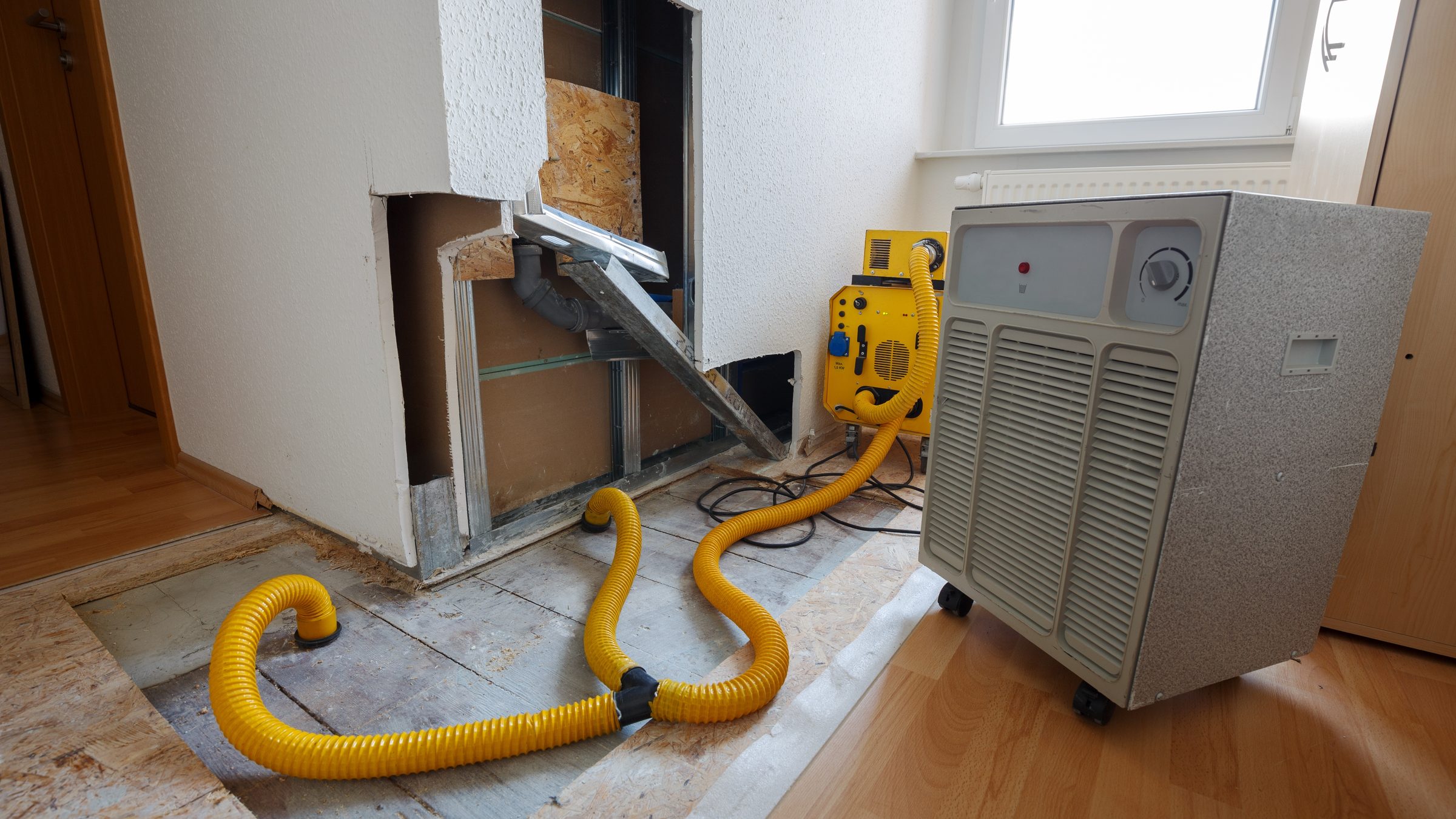
Water mitigation comes first: stop the source, remove standing water, extract what a pump cannot lift and clean up whatever the water contaminated. Then structural drying, with air movers and dehumidifiers running until moisture meters show the framing, subfloor and drywall back at their dry standard. Rush the drying process and the hidden moisture left behind keeps doing further damage out of sight, which is where mold growth starts. The EPA’s guidance is to dry wet materials within 24 to 48 hours to prevent it, which is why the first day decides so much of the job.
Restoration is the second half: the structural repairs and finishes that restore the property to its pre-loss condition. None of it should start until the drying equipment is out and the moisture levels are logged. Ask any restoration company for that log before a water damage repair closes the walls, because it is the only proof the structure was dry, and it is what your insurance company will ask to see. The sequence is the same for every water damage cleanup, whether the source was a burst pipe, a flooded basement or a sewage backup. What changes is the water category. The industry sorts water into clean, gray and black, categories one to three, and sewage and floodwater are black water that carries bacteria and viruses, so porous materials they touched come out rather than get dried.
Until someone arrives, shut the water off at the main if the source is inside, stay off wet floors where the power may still be live, and do not run a household vacuum on standing water.
Our process
The water and flood damage restoration process in Hicksville
No step here is optional and none of them can be reordered. If a contractor skips one, ask which.
01
Emergency contact
A person answers, day or night. We confirm your address, the water source, and whether the power is safe.
02
Inspection and moisture mapping
We meter every affected surface and map how far the water actually traveled, which is almost always further than it looks.
03
Water extraction
Truck-mounted and portable extraction pulls standing water before it wicks further into the structure.
04
Drying and dehumidification
Air movers and dehumidifiers run to a target moisture content, monitored daily against the dry standard.
05
Cleaning and sanitizing
Affected contents and surfaces are cleaned, deodorized, and treated to stop secondary growth.
06
Restoration
Drywall, flooring, and finishes go back, and you get the full moisture log for your claim.
The clock started when the water did
What happens if you wait
Restoration is priced by how far the damage got, and damage is a function of time. This is the progression we see on almost every untreated water loss.
Minutes
Water finds every porous thing you own
It wicks up drywall, under flooring, and into subfloor and insulation. What you can see on the floor is a fraction of what is already wet.
1-24 hrs
Drywall swells, finishes bleed, odor starts
Furniture legs stain carpet. Laminate delaminates. Paper-faced drywall loses structural integrity and the first musty smell appears.
48-72 hrs
Mold begins to colonize
This is the line that changes the job. Past roughly 48 hours a drying job becomes a remediation job, and the cost and disruption both step up.
1 week +
Structural damage and health risk
Wood warps and swells, fasteners corrode, and spore counts climb. Restoration times and costs rise sharply, and some contents stop being salvageable.
Timelines describe typical residential water losses under normal indoor conditions. Category, temperature, humidity, and materials all shift them. An on-site inspection is the only way to know where your property sits.
Call us
Water damage emergency in Hicksville?
If it is a water emergency, call the Long Island line. A person picks up at any hour, asks where the water is coming from, and tells you straight whether it needs emergency water removal tonight or can wait for a daylight inspection.
Answered 24 hours a day, 7 days a week
Mold · by appointment
Mold removal in Hicksville
On a Levitt slab, mold tends to follow a leak nobody could see: carpet or flooring laid over a damp slab, with growth on the underside and along the tack strip long before anything shows on top. A smell of mildew in a house with no basement is worth taking seriously for exactly that reason.
In the rest of Hicksville’s 1950s houses the pattern is the ordinary inland one. A supply line or a water heater let go, it was dried with fans rather than dehumidifiers, and the colony behind the drywall shows up six weeks later.
Mold remediation is booked, not dispatched
Mold remediation is scheduled work. Nobody needs a crew at two in the morning for mold growth that took weeks to appear, and a contractor who sells it as an emergency is selling the fear rather than the fix. The job starts with a survey: where the hidden moisture is coming from, how far the growth goes behind the finish, and whether the area is large enough to fall under New York’s mold rules. Mold prevention after a water loss is mostly moisture control: dry the structure to its standard, then keep indoor humidity between 40 and 60 percent.
Once a project covers more than about ten square feet, Article 32 of the New York Labor Law separates the person who assesses the mold from the company that removes it, and the same firm may not do both on one job. That is why the clearance test at the end goes to an independent assessor, not to us. How mold inspection works on Long Island sets out the whole rule.
How mold damage is removed
Find the moisture source
Growth is the symptom. Remediation without fixing the water is a repeat visit.
Contain the area
Plastic barriers and negative air pressure keep mold spores out of the rooms that are clean.
Filter and remove
HEPA air filtration runs throughout. Porous material that cannot be cleaned comes out; hard surfaces are HEPA vacuumed and given an antimicrobial treatment.
Independent clearance
An assessor who did not do the work tests the space before anything is closed up.
Fire and smoke
Fire damage restoration in Hicksville
About four in ten Hicksville homes heat with oil, according to the Census Bureau’s 2020–24 estimates, against roughly a quarter across Nassau. In an original Levitt house the boiler was small enough to sit in the kitchen next to the other appliances, so a burner misfire there puts soot straight into the living space rather than into a basement.
A slab house also has nowhere to send the water the fire department used. With no basement below, it spreads across the floor and into everything sitting on it, and in a house with radiant tubing it is worth checking the slab before the flooring goes back down.
Two things hold on every fire job regardless of the house. The water the fire department used is a water loss in its own right and gets extracted and dried before any soot work starts. And soot is acidic: it keeps etching metal, glass and finishes for as long as it sits, which is why smoke damage cleanup is worth starting the day the property is released back to you. Odor elimination comes last, once the soot is off every surface, because deodorizing over soot does not last.
Claims
Will insurance cover water damage in Hicksville?
Hicksville’s claims are mostly the kind a homeowners policy is written for: sudden failures inside the house. FEMA’s flood-insurance records hold 27 claims from the whole 11801 ZIP code in their entire history, so flood insurance is rarely the conversation here. Sewer and drain backup is, and it is usually a separate endorsement with its own limit.
On a slab leak the adjuster’s first question is how long it had been leaking, because a slow leak running for months is where coverage gets argued and restoration costs climb. The meter readings and photographs from the first visit are the answer to that question, which is why they come before anything is moved.
What a homeowners insurance claim usually covers
The general rule holds everywhere on the island. Sudden and accidental water from inside the house — a burst pipe or supply line, a failed water heater, a split washing-machine hose — is usually covered. Surface water coming in from outside is excluded from standard homeowners policies and is what flood insurance is for. Groundwater seeping through a foundation is a hard claim under either policy, sewer and drain backup is usually a separate endorsement with its own limit, and damage put down to long-term leaks is rarely covered at all.
What your insurance company will want to see
Report the loss to your insurer promptly. Most policies require prompt notice, and a late report is one more thing to argue about. We document damage the way adjusters ask for it: dated moisture readings, photographs of the property damage in every affected area before anything moves, and a line-item scope your insurance carrier can price. That is the insurance paperwork an adjuster actually reads. The claims process stays yours — we are a restoration contractor, not a public adjuster. What is covered, what is not, and how to file goes through it in full.
Serving Hicksville
Around Hicksville, NY
Crews work across Hicksville and the hamlets around it, from Levittown and Bethpage to Plainview, Syosset and Jericho, on the Long Island line.
Residential and commercial losses come in on the same line, so a home or business in Hicksville makes the same call. Commercial restoration in Nassau County covers what changes when it is a business.
- Levittown section
- Broadway (Route 107)
- Newbridge Road (Route 106)
- Old Country Road
- Jerusalem Avenue
- South Oyster Bay Road
- Woodbury Road
- Hicksville station
- Levittown
- Bethpage
- Plainview
- Syosset
- Jericho
Other Long Island towns
- SmithtownNissequogue groundwater, cesspool backups and the August 2024 storm.
- CommackOne hamlet, two towns: cloudbursts, cesspools and 1960s houses.
- MassapequaCanal homes, storm drains that back up at high tide, and the Sandy record.
- BabylonBay flooding south of Montauk Highway, tidal drains and the county sewer.
FAQ
Questions Hicksville homeowners ask
If yours is not here, call and ask. You will get a straight answer, not a callback from a sales team.
My Hicksville house has no basement. How can there be water under the floor?
How does water damage restoration work?
What does a sewage backup mean in a Hicksville house?
Do I need flood insurance in Hicksville?
Do you cover Levittown, Bethpage and Plainview too?
Water damage in Hicksville? Call before you start moving things
Where things were sitting when the water arrived is part of the insurance record. Call, tell us where the water came from and how long it has been there, and we will tell you honestly what it needs.
Answered by a person, 24/7· Rapid response teams on standby· We handle your insurance